Buying a CNC sheet metal cutting machine is one of the most significant capital decisions a manufacturing business makes. Get it right and it transforms your production capacity, cut quality, and profit margins. Get it wrong and you are locked into years of underperformance, high operating costs, and frustrating after-sales experiences.
The Indian market offers hundreds of CNC sheet metal cutting machine options across a wide price range, from portable entry-level systems to industrial-grade fiber laser machines. Every supplier claims theirs is the best. Every brochure lists impressive specifications. The challenge is knowing which specifications actually matter for your specific production requirement, and which questions to ask before signing a purchase order.
This guide is written for factory owners, production managers, and purchase decision-makers in India who are evaluating CNC sheet metal cutting machines for the first time or upgrading existing equipment. By the end, you will have a clear framework for evaluating any machine and any manufacturer, regardless of what technology or brand they are selling.
Step 1: Understand What You Are Actually Cutting
The single most important factor in choosing a CNC sheet metal cutting machine is not the machine. It is your material.
Before speaking to any supplier, answer these four questions about your own production requirements:
What metals do you cut? Mild steel, stainless steel, aluminium, copper, and brass all behave differently under different cutting processes. Mild steel can be cut by plasma, laser, or oxyfuel. Stainless steel and aluminium cut best on a fiber laser. Copper and brass require a fiber laser specifically, as other processes struggle with highly reflective metals.
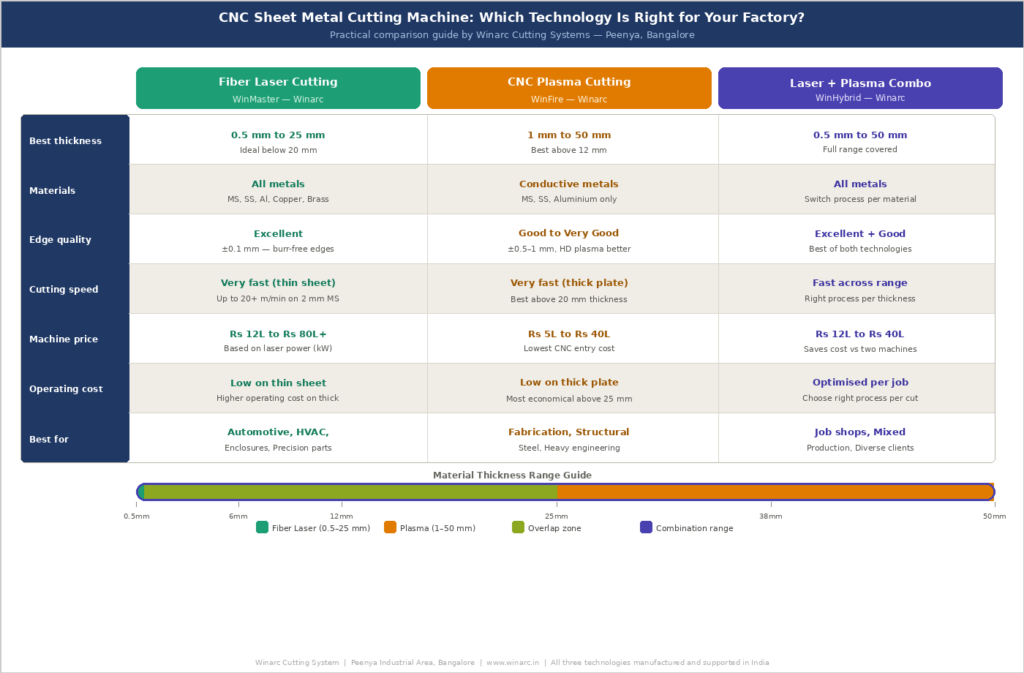
What is your typical sheet thickness range? This is the specification that narrows your technology choice faster than anything else. Sheets under 6 mm cut fastest and most economically on a fiber laser. Sheets from 6 mm to 25 mm can be handled by both plasma and laser, with trade-offs in speed, edge quality, and cost. Sheets above 25 mm cut most economically on a CNC plasma cutting machine. Sheets above 50 mm require plasma or oxyfuel.
What is your production volume? A shop cutting 10 sheets per day has completely different machine requirements from one cutting 100 sheets per day. Higher volumes demand faster machines, automatic pallet changers, and more robust drive systems. Lower volumes can use simpler configurations with lower upfront investment.
What edge quality does your product require? If your cut parts go directly to assembly or to a customer without secondary finishing, you need tight tolerances and clean edges. Fiber laser cutting delivers ±0.1 mm tolerance with burr-free edges. Plasma cutting delivers ±0.5 to 1 mm tolerance with a slightly bevelled edge that may need light grinding on precision work. If secondary finishing is acceptable in your process, plasma gives you more economical thick-plate cutting without penalty.
Only once you have clear answers to these four questions should you begin evaluating CNC sheet metal cutting machines and suppliers.
Step 2: Match the Right Cutting Technology to Your Requirement
Three primary technologies power CNC sheet metal cutting machines in the Indian market. Each has a specific strength range, and choosing the wrong one is an expensive mistake that cannot be fixed without replacing the machine.
CNC fiber laser cutting machine
The fiber laser is the most precise and versatile CNC sheet metal cutting machine available today. It uses a concentrated beam of light transmitted through a fiber-optic cable to melt and vaporise metal with exceptional accuracy.
Strengths: Best edge quality on the market. Cuts all metals including reflective materials like copper and brass. Fast cutting speed on thin to medium sheets. Minimal heat-affected zone. Virtually no secondary finishing required on most applications.
Best thickness range: 0.5 mm to 25 mm for most production applications. Above 25 mm, operating cost rises sharply.
Best for: Automotive component manufacturers, HVAC fabricators, precision sheet metal shops, electrical enclosure manufacturers, aerospace suppliers, furniture and architectural metalwork. Any application where edge quality and tight tolerances directly affect the finished product.
Price range in India: CNC fiber laser cutting machines range from approximately Rs 12 lakh for entry-level 1.5 kW systems to Rs 80 lakh and above for high-power industrial configurations. The laser power rating is the primary price driver within this range.
Winarc’s WinPro CNC fiber laser cutting machine offers power options from 2 kW to 20 kW with a 4000 mm x 2000 mm working area, EtherCAT communication, and an automatic dual pallet changer for uninterrupted production.
CNC plasma cutting machine
The CNC plasma cutting machine uses a high-temperature ionised gas arc to melt and remove metal. It handles a wider thickness range than laser at a lower machine cost, making it the most widely used CNC sheet metal cutting machine across Indian fabrication shops.
Strengths: Wide thickness capability. Lower machine cost than equivalent fiber laser. Faster cutting speed on thick mild steel. Tolerant of material surface condition. Multi-torch configurations available for high-volume parallel cutting.
Best thickness range: 1 mm to 50 mm for general production. High-definition plasma configurations approach laser quality on plates up to 25 mm.
Best for: Metal fabrication shops, structural steel contractors, heavy engineering, automotive frame fabrication, general manufacturing where material is primarily mild steel and precision requirements are moderate.
Price range in India: CNC plasma cutting machines range from approximately Rs 5 lakh for standard gantry configurations to Rs 40 lakh for large-bed high-definition systems.
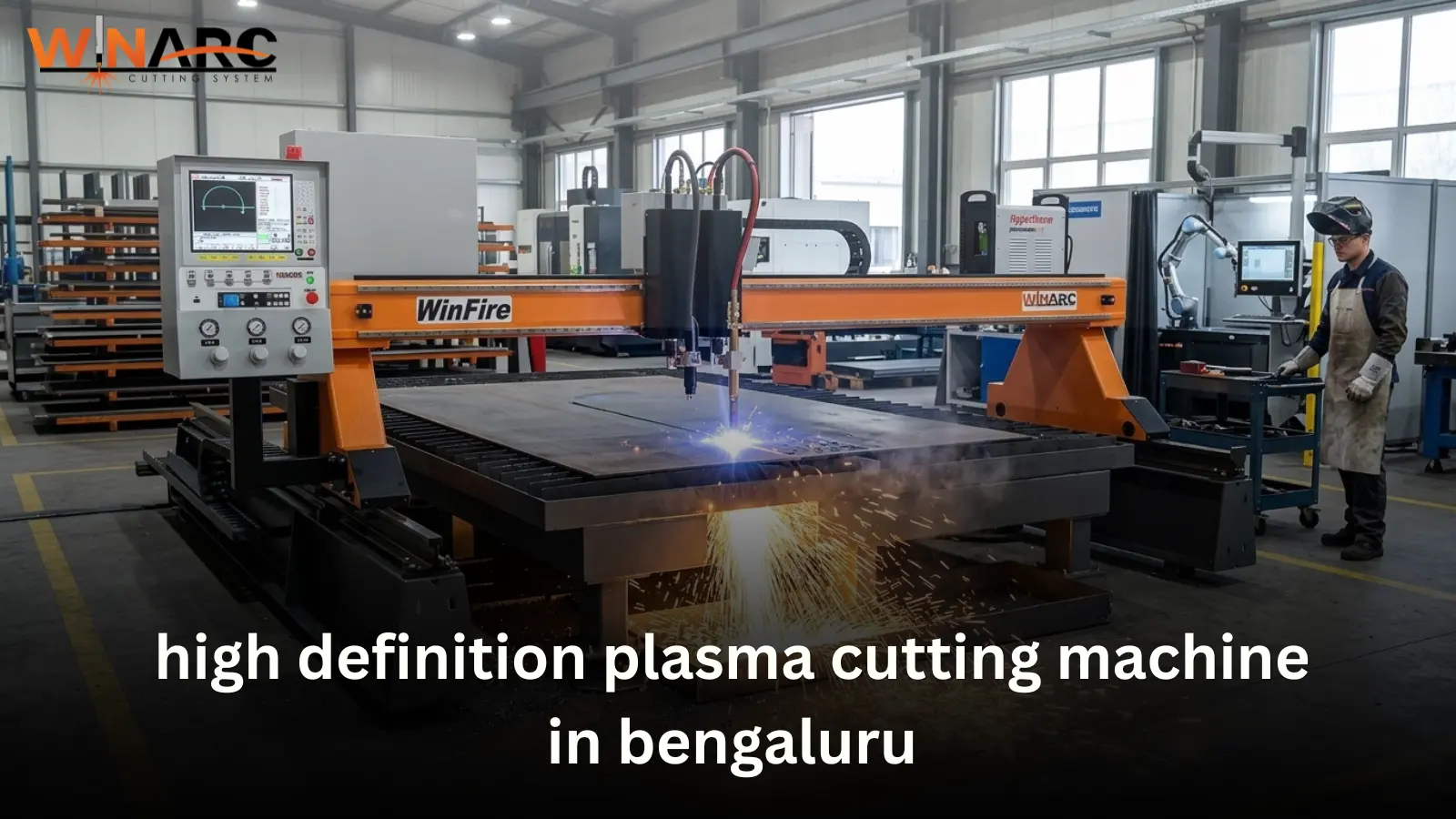
Winarc’s WinFire CNC plasma cutting machine is the highest-selling model in the Winarc range, compatible with all plasma sources from entry-level to high-definition, and built with machined railway rails and dual servo motors for industrial-grade accuracy and reliability.
CNC plasma and laser combination machine
For fabrication shops cutting a mix of thin precision parts and thicker structural sections, a combination CNC sheet metal cutting machine handles both processes on the same gantry. This eliminates the need for two separate machines and maximises floor space efficiency.
Best for: Job shops and fabrication contractors with diverse customer requirements across material types and thickness ranges.
Winarc’s WinHybrid combination machine switches between plasma and laser modes to handle the full spectrum of cutting requirements from a single installation.
Step 3: Evaluate the Machine Specifications That Actually Matter
Once you know which technology suits your production requirement, these are the specifications that separate a machine built for genuine industrial performance from one that will disappoint in production.
Drive system: servo motors vs stepper motors
This is the specification that most buyers overlook and most suppliers avoid mentioning clearly. Servo motors deliver precise, consistent positioning under load. They respond faster, hold accuracy better across long production runs, and last significantly longer in industrial environments than stepper motors.
Stepper motors are cheaper and adequate for light-duty or low-volume use. Under sustained production loads, they lose steps, meaning the machine gradually drifts from the programmed cut path. This shows up as dimensional inaccuracy and inconsistent cut profiles.
Any CNC sheet metal cutting machine intended for serious industrial production must use servo motors on all axes. Ask every supplier directly: servo or stepper? If they hesitate or deflect, that is your answer.
CNC controller and nesting software
The controller determines how intelligently the machine uses your material. Advanced controllers with nesting software automatically arrange multiple profiles on a single sheet to minimise scrap. Basic controllers run simple shapes from a library. For a production environment, nesting capability directly affects material cost per part.
Ask specifically: which controller brand is fitted, does it support nesting software import of DXF and DWG files, and is the nesting software included or charged separately?
Winarc’s CNC sheet metal cutting machines use the Fscut EtherCAT controller with CypCutE 2D cutting software, which supports smooth micro-joint, fast cutting, and circle centre functions for a wide range of production requirements.
Frame construction and stress relief
The machine frame is the foundation of long-term accuracy. A frame fabricated from mild steel structural sections and properly stress-relieved before machining will hold its dimensional accuracy for years under heavy production loads. A frame that skips stress-relieving or uses lighter section material will show progressive accuracy deterioration within 12 to 18 months of heavy use.
Ask your supplier: is the machine frame stress-relieved before machining? What is the rail specification and which brand are the linear guides?
Winarc builds all machine beds from MS structural tubes and plate fabrication, stress-relieved before machining and finished with blasting and painting for both accuracy and durability.
Laser source or plasma source specification
For fiber laser machines, the laser source is the single highest-value component. Confirm the laser source brand, power rating in kilowatts, and rated operational life in hours. Quality fiber laser sources carry a 100,000-hour rated lifespan.
For plasma machines, confirm the plasma source amperage, brand, and whether it is air plasma or gas plasma. High-definition plasma sources deliver significantly better cut quality than standard air plasma, particularly on plates between 6 mm and 25 mm.
Cutting bed size
Standard cutting bed size in the Indian market is 1500 mm x 3000 mm. If you regularly cut full-size MS plates (2000 mm x 6000 mm or larger), confirm the machine bed accommodates your actual sheet size. A machine with a smaller bed than your material forces repeated repositioning and introduces joint errors.
Winarc’s WinMaster offers a 4000 mm x 2000 mm working area with dual automatic pallet changer, allowing one sheet to be loaded while the other is being cut, maximising uptime.
Step 4: Assess the Manufacturer, Not Just the Machine
In the Indian CNC sheet metal cutting machine market, the machine you buy is only part of the investment. The manufacturer’s ability to support that machine over its operational life is equally critical.
A CNC sheet metal cutting machine running in production for 10 years needs service visits, spare parts, software updates, and operator training at various points in its life. The manufacturer you choose in year one will determine your total cost of ownership across that entire period.
Question 1: Where is the manufacturer located?
A manufacturer based in India, close to your facility, can provide faster on-site service than an importer representing an overseas brand. When a machine stops in production, every hour of downtime costs real money. A manufacturer in Bangalore can reach customers across South India within 24 hours. An overseas brand with a single national service partner may take days or weeks to respond on-site.
Winarc manufactures all machines at our facility in Peenya, Bangalore, one of India’s largest industrial zones. Our engineering team is based at the same location, enabling fast response for customers across South India.
Question 2: Are spare parts and consumables stocked domestically?
This question separates genuine manufacturers from importers and assemblers. A true manufacturer controls their supply chain and stocks critical spare parts domestically. An importer depends on overseas shipments for anything beyond basic consumables, which can take 2 to 6 weeks to arrive.
Ask specifically: where are your spare parts stocked? What is the typical lead time for a replacement servo drive, a laser source module, or a cutting head assembly?
Question 3: Can you visit the factory and see the machine running?
Any reputable CNC sheet metal cutting machine manufacturer will invite you to visit their manufacturing facility, inspect the machine in production, and run demonstration cuts on your own material or material of equivalent specification.
If a supplier is reluctant to arrange a factory visit or demonstration, that reluctance is itself a specification worth noting. Winarc actively encourages prospective customers to visit our Peenya facility and see our machines running before making any purchase decision.
Question 4: What do existing customers say?
Ask the manufacturer for references from customers who have been running their machines for at least 12 to 24 months. A machine that performs well in the first six months and then develops problems is more damaging than one that never performed. Long-term customer feedback reveals the true quality of both the machine and the after-sales support.
Question 5: What does the warranty actually cover?
Standard warranty in the Indian CNC sheet metal cutting machine market is 12 months from commissioning. But the wording of the warranty matters as much as the duration. Ask specifically: does it cover the laser source or plasma source, the servo motors and drives, the CNC controller, and the machine frame? What is excluded? What are the conditions that would void the warranty?
Winarc provides a 12-month warranty from commissioning date covering defects in material and design, with a clear service contact at service1@winarc.in and a defined claim process for all warranty issues.
Question 6: Is training included?
Operating a CNC sheet metal cutting machine effectively requires trained operators. The best machines produce poor results in the hands of untrained operators. Confirm whether the manufacturer provides operator training at commissioning, and whether refresher training or advanced training is available as your production complexity grows.
Step 5: Calculate Total Cost of Ownership, Not Just Machine Price
The purchase price of a CNC sheet metal cutting machine is the beginning of the cost, not the end. A complete cost evaluation should include all of these elements.
Operating cost per hour includes electricity consumption (a typical 6 kW fiber laser machine consumes approximately 35 kW gross), assist gas cost (nitrogen, oxygen, or compressed air depending on application), and consumables (cutting nozzles, protective lenses, and torch components depending on technology).
Maintenance cost includes scheduled preventive maintenance, periodic replacement of wear components, and unplanned repairs. A machine with better-quality components has lower maintenance cost over its life even if the purchase price is higher.
Productivity value is the cost that most buyers fail to calculate. A machine with an automatic pallet changer produces more parts per shift than one requiring manual loading. A machine with faster cutting speed cuts more metres per hour. A machine with better nesting software wastes less material per sheet. These differences compound significantly over years of production.
Downtime cost is the hidden cost that reveals the true value of after-sales support. A machine that runs at 95% uptime with a responsive local manufacturer is worth significantly more than a cheaper machine running at 80% uptime with slow service response.
India’s manufacturing sector is expanding significantly, supported by the Make in India initiative and growing domestic demand across automotive, aerospace, construction, and industrial equipment sectors. Investing in a CNC sheet metal cutting machine with the right total cost of ownership is increasingly a competitive necessity, not just a productivity improvement.
The Indian Machine Tool Manufacturers Association (IMTMA) recommends that buyers evaluate CNC cutting machines against a total lifecycle cost framework rather than purchase price alone, a principle that applies directly to CNC sheet metal cutting machine procurement decisions.
The 7 Red Flags to Watch for When Evaluating Suppliers
After evaluating hundreds of CNC sheet metal cutting machine buyers and their purchase decisions, these are the warning signs that consistently predict a poor outcome.
Red flag 1: The supplier cannot clearly state whether servo motors or stepper motors are used on the drive axes. Genuine industrial machine manufacturers know and communicate this specification precisely.
Red flag 2: The quoted price is significantly lower than comparable machines in the market. A CNC sheet metal cutting machine priced 30 to 40 percent below market for its specification category almost always reflects compromised components, particularly in the drive system or frame.
Red flag 3: The supplier is based overseas or operates through multiple distribution layers with no direct service capability in India. Every layer between you and the manufacturer increases the service response time when something goes wrong.
Red flag 4: The supplier is reluctant to arrange a factory visit or live demonstration cut. A machine that cannot be demonstrated running is a machine the supplier does not want you to inspect too closely.
Red flag 5: The warranty terms are vague, short, or full of exclusions that effectively cover nothing meaningful. Read the warranty document before signing the purchase order, not after.
Red flag 6: Spare parts and consumables are available only from overseas, or the supplier cannot confirm domestic stocking of critical components.
Red flag 7: The supplier cannot provide references from customers who have run the machine for 12 months or more. Brand-new or short-tenure customers tell you nothing about long-term machine reliability or service quality.
Frequently Asked Questions
Which CNC machine is best for sheet metal cutting?
The best CNC sheet metal cutting machine depends entirely on your material and thickness requirements. For thin to medium sheets (0.5 mm to 25 mm) across mixed metals including stainless steel, aluminium, and mild steel, a CNC fiber laser cutting machine delivers the best combination of precision, speed, and versatility. For mild steel sheets and plates above 25 mm where operating cost is the primary concern, a CNC plasma cutting machine is more economical. For shops cutting both thin precision parts and thicker structural sections, a combination plasma and laser machine handles the full range from a single installation.
Is laser or plasma better for sheet metal cutting?
For thin sheets (under 6 mm), fiber laser cutting is faster, more precise, and produces cleaner edges than plasma cutting. For thick mild steel plates (above 25 mm), plasma cutting is more economical in operating cost and handles the thickness range more effectively. For the middle range of 6 mm to 25 mm, both technologies are viable and the choice depends on the edge quality your product requires. If parts go directly to assembly without secondary finishing, laser is the better choice. If secondary grinding is acceptable, plasma offers lower operating cost on this thickness range.
What is the price of a CNC sheet metal cutting machine in India?
CNC sheet metal cutting machine prices in India range from approximately Rs 5 lakh for standard gantry plasma configurations to Rs 80 lakh and above for high-power fiber laser systems with automatic material handling. The laser power rating, bed size, plasma source specification, and automation level are the primary price drivers. Always evaluate total cost of ownership including operating cost, consumables, and maintenance alongside the purchase price when comparing machines.
How do I choose a CNC sheet metal cutting machine manufacturer in India?
Choose a manufacturer who is based in India with a direct service team, who stocks spare parts domestically, who invites factory visits and live demonstrations, who provides customer references from machines running for 12 months or more, and who offers a clearly worded warranty covering all major machine systems. Avoid importers with no direct service capability, suppliers who cannot demonstrate the machine, and any quotation that appears significantly below market price for the stated specification.
Why Indian Fabricators Choose Winarc
Winarc Cutting System has been manufacturing CNC sheet metal cutting machines from our facility in Peenya Industrial Area, Bangalore since 2018. We supply metal fabricators, automotive component manufacturers, structural steel contractors, HVAC fabricators, and heavy engineering shops across India.
Our range of CNC sheet metal cutting machines covers every major cutting technology and production requirement.
The WinFire CNC plasma cutting machine is our highest-selling model, built for general fabrication shops cutting mild steel from 1 mm to 50 mm across high production volumes. Compatible with all plasma sources from standard to high-definition.
The WinMaster CNC fiber laser cutting machine delivers exceptional precision for thin to medium sheet cutting across all major metals, with power options from 2 kW to 20 kW and a 4000 mm x 2000 mm working area with automatic dual pallet changer.
The WinHybrid combination machine handles both plate and tube cutting from a single installation, making it the most versatile CNC sheet metal cutting machine in the Winarc range for job shops and multi-product fabricators.
All machines are manufactured at our Peenya facility. All machines carry a 12-month warranty. Our engineering team provides on-site commissioning, operator training, and direct after-sales service across India.
Request a free technical consultation and machine recommendation for your production requirement
Explore more from Winarc: