If your factory cuts mild steel plates above 50 mm for shipbuilding, bridge fabrication, heavy structural work, or pressure vessel manufacturing a CNC oxyfuel cutting machine is almost certainly the most cost-effective tool available to you. Not plasma. Not laser. Oxyfuel.
Yet most buyers searching for a CNC oxyfuel cutting machine in India get stuck at the same three questions: What exactly is oxyfuel cutting and how does it work? When does it make more sense than plasma cutting? And what does a good machine actually cost?
This guide answers all three in depth, and goes further. By the end, you will know exactly which type of CNC oxyfuel cutting machine suits your production floor, what specifications to demand from any supplier, and how Winarc’s WinOxy compares against what is available in the Indian market today.
What Is a CNC Oxyfuel Cutting Machine?
A CNC oxyfuel cutting machine — also called a CNC flame cutting machine or CNC gas cutting machine — is a computer-controlled cutting system that uses a combination of oxygen and fuel gas to cut through mild steel plates with precision and repeatability.
The process works in two stages. First, the torch preheats the steel plate to its ignition temperature — approximately 870°C for mild steel. Once that temperature is reached, a high-pressure jet of pure oxygen is directed onto the heated metal. The oxygen reacts chemically with the iron in the steel, causing rapid oxidation — a controlled, accelerated version of rusting — that melts and ejects the metal cleanly along the programmed cutting path.
The CNC system — the computer numerical control unit — governs every movement of the torch. It translates your CAD design into precise torch movements, controls cutting speed, manages preheat timing, and ensures the same cut profile is repeated accurately across every plate, every shift, without operator variation.
Fuel gas options for a CNC oxyfuel cutting machine include acetylene (highest flame temperature, fastest preheat), LPG or propane (most widely used in India — economical and readily available), and natural gas (lowest cost per cubic metre where pipeline supply exists). The choice of fuel gas affects preheat time and gas cost but does not significantly change the quality of the final cut on mild steel.
Why Oxyfuel — and Not Plasma or Laser — for Thick Plate?
This is the most important question any heavy fabricator needs to answer correctly before purchasing equipment.
The thickness threshold
Plasma cutting is fast and precise on material up to 50–60 mm thick. Above that threshold, plasma becomes progressively less cost-effective — operating costs rise sharply, cutting speed drops, and edge quality can deteriorate on very thick sections.
A CNC oxyfuel cutting machine, by contrast, cuts mild steel from 6 mm all the way to 350 mm thickness — and does so at a fraction of the operating cost of plasma on heavy plate. This is the defining advantage of oxyfuel: no other thermal cutting technology matches its economy and reliability on ultra-thick mild steel.
The material constraint
This is equally important: oxyfuel cutting is chemically limited to mild steel and low-alloy carbon steels. It cannot cut stainless steel, aluminium, copper, or brass — because these metals do not oxidise the way mild steel does. If your factory primarily cuts mild steel in thicknesses above 50 mm, a CNC oxyfuel cutting machine is your best option. If you need to cut stainless steel, aluminium, or thin sheets of mixed metals, you need plasma or laser instead.
The multi-torch advantage
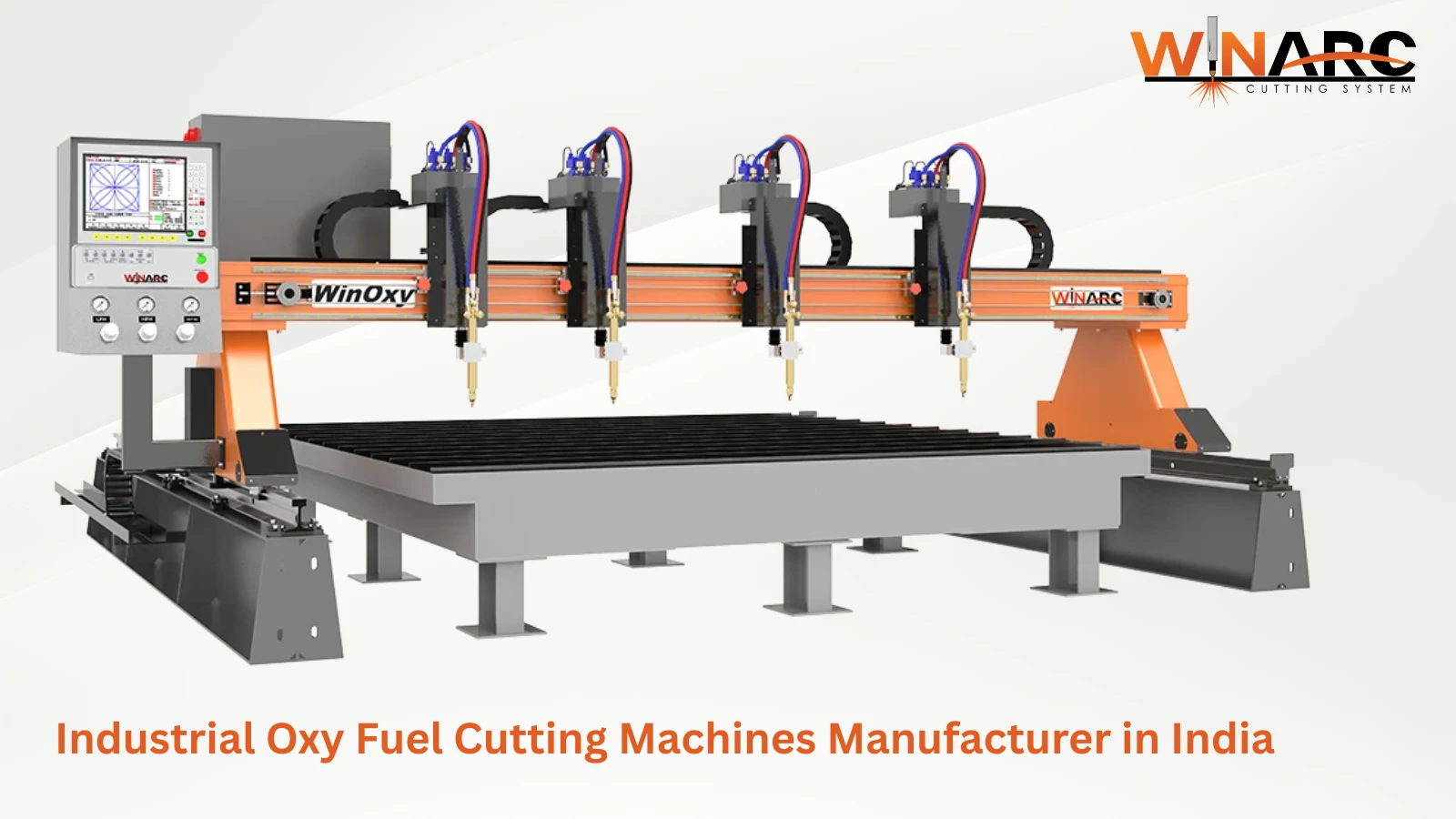
One unique capability of a CNC oxyfuel cutting machine is the ability to mount multiple cutting torches on a single gantry — cutting two, four, six, or even eight identical profiles simultaneously from the same plate. This multiplies output without multiplying machine cost, making it the dominant choice for high-volume production of thick structural components.
A single plasma torch cuts one profile at a time. A four-torch oxyfuel setup cuts four identical profiles simultaneously — at roughly the same operating cost per plate. For structural steel contractors and shipyards cutting large volumes of identical parts, this productivity multiplier is decisive.
Types of CNC Oxyfuel Cutting Machine in India
Understanding the four main configurations available in India will help you match the right machine to your production requirement.
1. Portable CNC Oxyfuel Cutting Machine
Price range: ₹2.5 lakh – ₹6 lakh
The portable CNC oxyfuel cutting machine uses a lightweight gantry that runs on rails placed directly on the workshop floor or on the cutting table. It is designed for smaller workshops, site work, and fabricators who need flexibility in cutting location. These machines carry one or two torches and are suited to plates up to 150 mm thick.
They are widely used across India in smaller structural fabrication shops, agricultural equipment manufacturers, and construction contractors who cut steel sections at project sites. The low entry cost and simple setup make portable CNC oxyfuel cutting machines the most common configuration in small and medium enterprises.
2. Gantry-Type CNC Oxyfuel Cutting Machine (Standard)
Price range: ₹6 lakh – ₹20 lakh
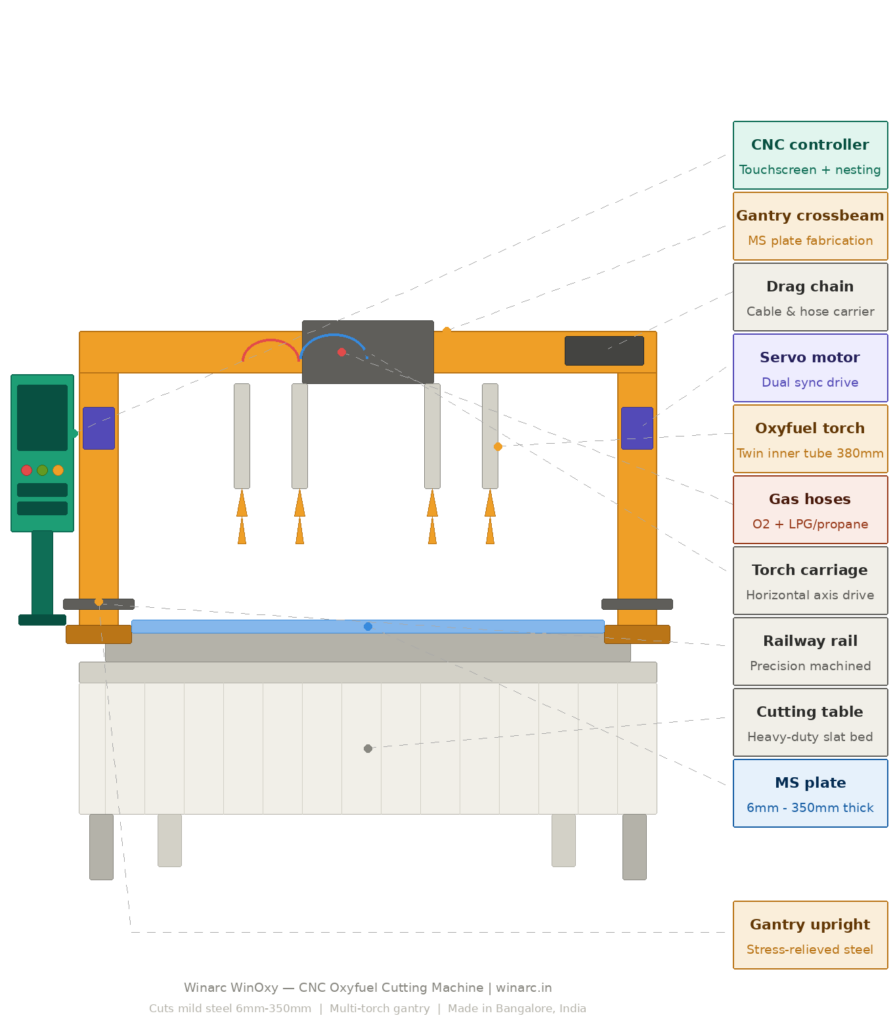
This is the most widely used CNC oxyfuel cutting machine configuration in Indian heavy industry. A rigid overhead gantry spans the full width of the cutting table, with one to four torches mounted on the crossbeam. Dual servo motors drive the longitudinal axis; the transverse axis carries the torch carriage.
The gantry-type CNC oxyfuel cutting machine handles plates from 6 mm up to 250–350 mm thickness with consistent accuracy. Bed sizes range from the standard 1500 mm × 3000 mm up to 3000 mm × 12000 mm for large structural plate work. This configuration is the right choice for most metal fabrication shops, structural steel contractors, and general heavy engineering workshops.
Winarc’s WinOxy falls in this category — a gantry-type CNC oxyfuel cutting machine engineered for continuous industrial production. The WinOxy cuts MS plates from 6 mm to 350 mm with a silver-brazed twin inner tube torch rated for cutting up to 380 mm thickness.
3. Heavy-Duty Multi-Torch CNC Oxyfuel Cutting Machine
Price range: ₹20 lakh – ₹55 lakh+
The heavy-duty multi-torch CNC oxyfuel cutting machine is purpose-built for shipbuilding, bridge fabrication, pressure vessel manufacturing, and large structural steel production. These machines carry four to eight torches simultaneously, with large cutting beds — typically 3000 mm × 8000 mm to 4000 mm × 16000 mm — and heavy structural frames built to run continuous, multi-shift production.
Strip cutting torch configurations are common on these machines — multiple torches set at fixed centres to cut identical parallel strips simultaneously, dramatically reducing cycle time on repetitive structural components. These are capital equipment purchases for serious heavy industry operations.
4. CNC Plasma + Oxyfuel Combination Machine
Price range: ₹12 lakh – ₹40 lakh
The combination CNC machine carries both a plasma torch and oxyfuel torches on the same gantry, allowing the operator to switch between processes depending on material and thickness. Thin or medium plates use the plasma head for speed and precision. Heavy plates switch to the oxyfuel torch for economy and thickness capability.
This is the most versatile configuration for fabricators who cut a wide range of material types and thicknesses — and do not want to invest in two separate machines. It is particularly popular in large job shops and fabrication contractors who serve diverse industries.
CNC Oxyfuel Cutting Machine: Key Specifications Explained
When evaluating any CNC oxyfuel cutting machine in India, these are the specifications that actually determine performance and long-term value.
Cutting thickness range
The most fundamental specification. Entry-level machines cut up to 100–150 mm. Mid-range gantry machines cut up to 250 mm. Heavy-duty machines cut up to 350 mm and beyond. The WinOxy by Winarc is rated for 6 mm to 350 mm one of the widest cutting ranges available in the Indian market at its price point.
Torch type and construction
The torch is the heart of a CNC oxyfuel cutting machine. Silver-brazed twin inner tube torches are the industrial standard, they handle higher gas pressures, distribute heat more evenly, and last significantly longer than single-tube alternatives. Always ask for the torch construction specification before purchasing.
Drive system: servo vs stepper
Servo motors deliver consistent positioning accuracy under load and over time. Stepper motors are cheaper but lose steps under heavy cutting loads — which translates to inaccurate cut profiles and requires frequent recalibration. Any CNC oxyfuel cutting machine intended for continuous industrial use must use servo motors on all axes.
The WinOxy uses dual synchronised servo motors on the longitudinal axis and a servo motor on the horizontal axis, paired with machined railway rails and rack and pinion transmission — the same drivetrain specification as Winarc’s plasma machines.
CNC controller and nesting software
The controller determines how complex a profile the machine can execute and how efficiently it uses the plate. Advanced controllers support full nesting — automatically arranging multiple different profiles on a single plate to minimise material waste. Basic controllers run simple shapes from a shape library. For production use, nesting capability is essential.
Number of torch stations
The ability to add torches later as production volume grows is a critical specification that many buyers overlook. Confirm with your supplier whether the gantry rail and controller support additional torches, and what the upgrade cost is. The WinOxy supports multiple torch configurations to suit different production volumes.
Automatic torch height control
Automatic torch height control (THC) maintains the correct standoff distance between the torch tip and the plate surface as the plate varies in flatness. Without THC, the operator must manually adjust height — introducing inconsistency and slowing production. On a CNC oxyfuel cutting machine, THC is particularly important when cutting warped or scale-covered heavy plates.
Industries That Use CNC Oxyfuel Cutting Machines in India
A CNC oxyfuel cutting machine is the dominant cutting technology in specific industries where thick mild steel plate is the primary material.
Shipbuilding and ship repair — hull plates, deck sections, rib frames, and keel components are cut from heavy MS plates ranging from 20 mm to 100 mm thick. Multiple torches on large-bed oxyfuel machines are standard in Indian shipyards.
Bridge and infrastructure construction — structural steel for road and rail bridges uses heavy plate sections. Oxyfuel cutting handles the 40–120 mm web plates and flange plates that dominate this application.
Pressure vessel and boiler manufacturing — pressure vessels use thick-wall MS plate — typically 25 mm to 100 mm. The clean, consistent edge of a well-set CNC oxyfuel cutting machine meets the edge preparation standards required before welding — typically classified under ISO 9013, the international standard for thermal cutting quality.
Heavy structural steel fabrication — columns, beams, base plates, and connecting gussets for industrial buildings and heavy machinery frames are cut from 20–80 mm plate. Oxyfuel cutting delivers the lowest cost per metre of cut in this thickness range.
Mining and earthmoving equipment — bucket lips, wear plates, loader arms, and dozer components use heavy-gauge mild steel. CNC oxyfuel cutting provides the cutting capacity and operating economy that these applications require.
Oil and gas fabrication — base plates, pipe flanges, support frames, and structural padeyes are cut from thick MS plate. The combination of thickness capability and low gas cost makes oxyfuel the preferred process. With India’s manufacturing sector expanding rapidly under the Make in India initiative, demand for reliable thick-plate cutting equipment across all these industries continues to grow.
CNC Oxyfuel Cutting Machine vs Plasma Cutting: When to Choose Which
Many Indian fabricators run both processes and switch between them depending on the job. However, if you are purchasing a single machine, this decision framework will guide you correctly.
| Factor | Choose CNC Oxyfuel | Choose CNC Plasma |
| Material | Mild steel only | Mild steel, SS, aluminium, copper |
| Thickness | Above 50 mm | Below 50 mm |
| Operating cost on thick plate | Lower | Higher |
| Multi-torch capability | Yes — up to 8 torches | Limited |
| Preheat required | Yes — adds cycle time | No |
| Edge quality on thin plate | Rough | Clean and precise |
| Machine investment | Lower | Higher |
| Cutting speed on thin plate | Slower | Faster |
The practical rule used across Indian heavy fabrication: use oxyfuel for anything above 50 mm in mild steel, and use plasma for everything below 50 mm or for any non-ferrous material. Fabricators with combination machines apply this rule automatically, switching torches based on the job.
What Is the Price of a CNC Oxyfuel Cutting Machine in India?
The price of a CNC oxyfuel cutting machine in India varies by configuration, bed size, number of torches, and controller quality. Here is a realistic price framework based on the current Indian market:
| Configuration | Price Range (₹) | Best For |
| Portable / bench-type | ₹2.5L – ₹6L | Small shops, site cutting, up to 150 mm |
| Gantry type (1–2 torch) | ₹6L – ₹14L | General fabrication, up to 250 mm |
| Gantry type (multi-torch) | ₹14L – ₹25L | High-volume structural, up to 350 mm |
| Heavy-duty large-bed | ₹25L – ₹55L+ | Shipbuilding, bridge, heavy industry |
| Plasma + oxyfuel combination | ₹12L – ₹40L | Mixed material and thickness production |
The operating cost advantage of a CNC oxyfuel cutting machine over plasma is most visible on thick plate. On 100 mm mild steel, oxyfuel operating cost is typically 40–60% lower per metre of cut compared to plasma — because it uses no expensive electrical consumables and the torch life on an oxyfuel machine is far longer than plasma consumables.
For fabricators cutting above 50 mm consistently, this operating cost advantage repays the machine investment significantly faster than the headline price difference between oxyfuel and plasma machines suggests.
Winarc WinOxy: CNC Oxyfuel Cutting Machine Made in India
The WinOxy is Winarc’s purpose-built CNC oxyfuel cutting machine, manufactured at our facility in Peenya, Bangalore. It is designed for the specific demands of Indian heavy fabrication — wide thickness range, robust construction, low maintenance, and after-sales support from a manufacturer based in India.
Key WinOxy specifications
Cutting thickness range: 6 mm to 350 mm mild steel — one of the widest ranges available in this machine class in India.
Torch: Silver-brazed twin inner tube construction, rated for cutting up to 380 mm. The twin inner tube design provides superior heat distribution and gas flow compared to single-tube torches — extending torch life and improving cut quality on heavy plate.
Drive system: Dual synchronised servo motors on the longitudinal axis. Servo motor on the horizontal axis. Machined railway rails with spur rack and pinion mechanism. This drivetrain delivers positioning accuracy and repeatability that stepper-based alternatives cannot match over sustained production use.
CNC controller: Advanced controller with intuitive interface, designed for continuous improvement with regular software updates. Supports nesting software for material optimisation.
Frame construction: Built with high-quality materials for durability and stability under heavy workloads — stress-relieved before machining to prevent long-term deformation.
Operation: User-friendly interface designed for both experienced operators and novice users. Low-cost operational profile: oxyfuel running costs are significantly lower than plasma, making the WinOxy one of the most economical thick-plate cutting solutions available to Indian fabricators.
After-sales: 12-month warranty from date of commissioning. Winarc engineers based in Peenya, Bangalore — rapid response for South India. Spare parts and torch consumables stocked domestically.
View full WinOxy specifications and request a quote →
5 Questions to Ask Before Buying Any CNC Oxyfuel Cutting Machine in India
Before signing a purchase order with any supplier, get clear written answers to these five questions:
1. What is the maximum cutting thickness and what torch is used? Ask for the torch brand, construction type (twin inner tube vs single), and the rated maximum cutting thickness. A machine quoted at “up to 300 mm” with a basic single-tube torch may not deliver that capability reliably in production.
2. What drive system powers the axes — servo or stepper? This is non-negotiable for industrial use. Stepper motors lose accuracy under heavy cutting loads. Any supplier who cannot clearly confirm servo motors on all axes is selling you a machine that will underperform within months.
3. Does the machine support additional torches — and at what cost? If your production volume grows, you want to add torches, not buy a new machine. Confirm the gantry rail width, controller capacity, and upgrade cost before purchasing.
4. What nesting software is compatible — and is it included? Nesting software dramatically reduces plate waste on a CNC oxyfuel cutting machine by efficiently packing multiple profiles onto each plate. Confirm whether software is included or charged separately, and which formats (DXF, DWG) it imports.
5. Where is the manufacturer located and what is their service response time? An oxyfuel machine running in production cannot wait three weeks for a service engineer. Confirm the manufacturer’s location, typical response time for on-site service, and local spare parts availability.
At Winarc, all five questions are answered clearly on every quotation. Our service engineers are based in Bangalore — the same city as our manufacturing facility — and our spare parts and torch consumables are always stocked domestically.
Frequently Asked Questions
What is a CNC oxyfuel cutting machine?
A CNC oxyfuel cutting machine is a computer-controlled flame cutting system that uses oxygen combined with a fuel gas — typically LPG, propane, or acetylene — to cut through mild steel plates. The CNC system controls the torch movement with precision, eliminating operator variation and delivering consistent, repeatable cuts at production speed. It is the preferred cutting technology for thick mild steel plates above 50 mm and is widely used in shipbuilding, bridge fabrication, pressure vessel manufacturing, and heavy structural steel production across India.
When should I choose a CNC oxyfuel cutting machine over plasma?
Choose a CNC oxyfuel cutting machine when you primarily cut mild steel plates thicker than 50 mm, when you need to run multiple torches simultaneously to increase throughput, or when operating cost on heavy plate is a primary concern. Choose plasma when you need to cut stainless steel, aluminium, or non-ferrous metals, when cutting thin sheets below 20 mm at high speed, or when edge finish quality on thin material is critical. Many Indian fabricators run both technologies — using the CNC oxyfuel cutting machine for thin and medium plate, and the CNC oxyfuel cutting machine for heavy plate work.
What thickness can a CNC oxyfuel cutting machine cut?
A standard gantry-type CNC oxyfuel cutting machine in India cuts mild steel from 6 mm up to 250–300 mm thickness. Heavy-duty machines with specialist torches can cut up to 350 mm and beyond. Winarc’s WinOxy is rated for 6 mm to 350 mm with its silver-brazed twin inner tube torch — making it one of the widest cutting range machines available at its price point in the Indian market.
What is the price of a CNC oxyfuel cutting machine in India?
CNC oxyfuel cutting machine prices in India range from approximately ₹2.5 lakh for portable models to ₹55 lakh and above for heavy-duty multi-torch large-bed systems. Standard gantry-type machines with one to two torches — the most common configuration for Indian fabrication shops — typically cost between ₹6 lakh and ₹20 lakh depending on bed size, torch specification, and controller quality. Contact Winarc for a detailed quotation based on your specific cutting requirements.
Ready to Invest in the Right CNC Oxyfuel Cutting Machine?
If your factory regularly cuts mild steel plate above 50 mm — or you want the lowest operating cost for thick plate cutting — the WinOxy CNC oxyfuel cutting machine is built for exactly that work. Manufactured in Bangalore by Winarc, it combines wide cutting range, robust servo-driven construction, and the after-sales reliability that Indian fabricators need.
Explore more from Winarc: