Large-scale organisations need cutting machines that deliver real results, productivity, and ROI. Precision, reliability, and efficiency are core requirements in metal cutting. With the right oxyfuel cutting machine manufacturers, you can make all the difference. Winarc Cutting System is one of the most trusted names in this space, and their WinOxy is an oxyfuel cutting machine notable for its robust design, tough performance, and customer-focused features. This guide covers everything you need to know before investing in one.
What Is an Oxyfuel Cutting Machine?
An oxyfuel cutting machine uses a torch that mixes oxygen and a fuel gas (acetylene, propane, or natural gas) to cut through thick metal plates. The process works by heating the metal to its ignition temperature, then blowing away the oxidised molten metal using a high-pressure stream of oxygen.
This technique is best suited for cutting mild steel and is widely used in shipbuilding, construction, bridge fabrication, and heavy machinery manufacturing because it can cut steel plates up to 380 mm thick, a range that plasma and laser cutting machines cannot economically match.
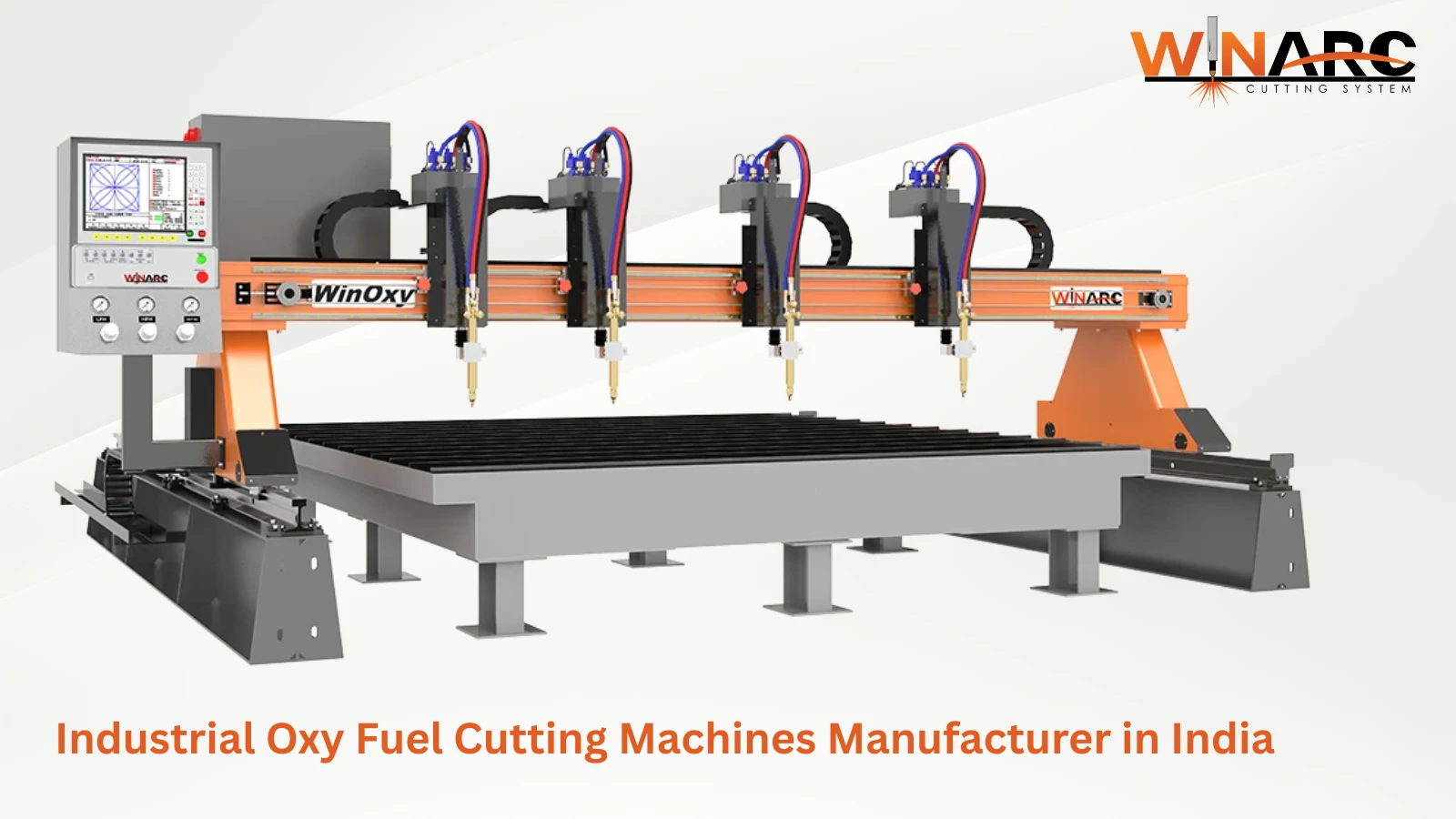
Machines such as the WinOxy model provide wide cutting capability, accommodating plate thickness from 6 mm to 380 mm, with features that deliver high accuracy and smooth operation across both thin and ultra-thick mild steel.
How CNC Oxyfuel Cutting Machine Manufacturers Build Their Machines to Work
The fundamentals of oxyfuel cutting are straightforward. Here is how the process works:
Preheating: A blend of fuel gas and oxygen heats the steel until it reaches its ignition temperature, typically around 870 degrees Celsius for mild steel.
Oxidation: Once sufficiently heated, pure oxygen is directed at the cutting zone, starting the chemical oxidation reaction that drives the cut.
Ejection: The high-pressure oxygen stream ejects the molten metal from the kerf, creating a clean, narrow cut path.
This process depends on precise control and consistent motion. WinOxy machines, for example, use spur rack and pinion drive systems powered by dual synchronised servo motors on machined rails, delivering ultra-smooth motion and accurate cuts even on very large workpieces at full bed length.
Key Components That Separate Good Oxyfuel Cutting Machine Manufacturers from the Rest
A high-performance CNC oxyfuel cutting machine involves considerably more than just a cutting torch. Here is what leading oxyfuel cutting machine manufacturers, including Winarc, incorporate into their equipment:
Cutting torch: Built with silver-brazed twin inner tube construction for reliable performance on thick mild steel. This design handles sustained high-temperature operation and provides consistent gas flow for clean cuts.
Linear guides and bearings: Precision linear guides provide accurate, repeatable motion across the full length of the cutting bed. This is critical for lengthy cuts and complex profiles.
Servo motors and drives: Dual servo motors provide responsive, controlled motion along the X and Y axes, maintaining precise cutting patterns at high traverse speeds.
CNC controller and nesting software: An advanced CNC controller with compatible nesting software allows operators to import CAD drawings, optimise plate nesting to minimise material waste, and execute cutting programs with minimal manual input.
Automatic torch height control (THC): Maintains the correct standoff distance between the torch tip and the plate surface automatically, compensating for plate warping and surface irregularities in real time. Critical for consistent cut quality on heavy plate.
Operator safety and ergonomics: Emergency stop buttons, robust machine guards, and clear sightlines to the cutting zone are standard safety requirements. An ergonomic operator interface reduces fatigue during long production shifts.
Industries That Rely on Oxyfuel Cutting Machine Manufacturers in India
Understanding which industries depend on oxyfuel cutting machines helps clarify whether this technology is right for your production. Oxyfuel is the dominant cutting process in any application involving thick mild steel plate.
Shipbuilding and ship repair: Hull plates, deck sections, and structural frames are cut from mild steel ranging from 20 mm to 100 mm thick. Multi-torch oxyfuel gantries are standard equipment in Indian shipyards at Mumbai, Cochin, and Visakhapatnam.
Bridge and infrastructure construction: Structural steel for road and rail bridges uses heavy plate sections up to 80 mm thick. Oxyfuel cutting handles web plates and flange plates that form the backbone of bridge construction.
Pressure vessel and boiler manufacturing: Pressure vessels use thick mild steel shells, typically 25 mm to 80 mm, cut to precise dimensions before welding. Edge quality from a well-configured oxyfuel cutting machine meets the weld preparation standards required for pressure vessel certification.
Heavy machinery and mining equipment: Bulldozer buckets, excavator arms, crane booms, and loader frames are fabricated from 25 mm to 80 mm mild steel. CNC oxyfuel cutting machines deliver the throughput and operating economy that make these components cost-effective to produce.
Pre-engineered building (PEB) fabrication: Base plates, gussets, and stiffeners for industrial buildings are cut from 20 mm to 60 mm mild steel plate. Oxyfuel provides the lowest cost per metre of cut in this thickness range.
India’s manufacturing sector is growing rapidly, supported by the Make in India initiative and major infrastructure investment programs including Bharatmala and PM Gati Shakti. This growth is directly increasing demand for oxyfuel cutting machine manufacturers who can support large-scale steel fabrication operations across the country.
Oxyfuel vs Plasma Cutting: When to Choose Oxyfuel
One of the most common questions buyers ask oxyfuel cutting machine manufacturers is whether they should choose oxyfuel or plasma. The answer depends on your material and thickness.
Factor | Oxyfuel cutting | Plasma cutting |
Material | Mild steel only | Mild steel, SS, aluminium |
Best thickness range | 25 mm to 380 mm | 1 mm to 50 mm |
Operating cost on thick plate | Lowest | Higher above 25 mm |
Multi-torch capability | Up to 8 torches | Limited |
Preheat required | Yes | No |
Edge quality on thin sheet | Fair | Good to excellent |
Machine investment | Lower | Moderate |
Cutting speed on thin plate | Slower | Faster |
The practical rule used across Indian heavy fabrication: use oxyfuel for mild steel above 25 mm to 50 mm, and use plasma for material below that threshold or for stainless steel and aluminium. Many fabrication companies run both: a plasma machine for thin and medium plate, and an oxyfuel machine for heavy plate work.
Why Choose Winarc Over Other Oxyfuel Cutting Machine Manufacturers?
There are several oxyfuel cutting machine manufacturers operating in India, but few combine the engineering depth, product range, and after-sales infrastructure that Winarc offers. Here is what makes the difference:
Flexible cutting range: The WinOxy accepts material from 6 mm to 380 mm, covering the full range of heavy plate cutting requirements from general fabrication to shipbuilding.
Scalable torch setup: The WinOxy accommodates 1 to 8 torches on a single gantry, scaling output to match production volume. Four torches cutting simultaneously quadruples throughput without quadrupling machine cost.
Customisable bed sizes: Working area is configurable from 1500 mm to 6000 mm in width and 3000 mm to 30000 mm in length, matching the machine precisely to your floor space and plate size requirements.
High-speed precision: Maximum traverse speed of 12000 mm/min with positional accuracy of plus or minus 0.3 mm, delivering close tolerances at production speeds.
Durability: Built with high-quality structural materials, stress-relieved before machining, and finished with blasting and painting for long-term stability under continuous production use.
Direct manufacturer support: Winarc manufactures the WinOxy at our Peenya, Bangalore facility. Our engineering team provides on-site service across South India, and all spare parts and torch consumables are stocked domestically for fast availability.
The Indian Machine Tool Manufacturers’ Association (IMTMA) recognises oxyfuel cutting as a foundational technology in India’s heavy fabrication and infrastructure manufacturing sectors.
WinOxy Technical Specifications
Specification | WinOxy |
Cutting thickness | 6 mm to 380 mm (mild steel) |
Cutting width | 1500 mm to 6000 mm |
Cutting length | 3000 mm to 30000 mm |
Number of torches | 1 to 8 (configurable) |
Max traverse speed | 12,000 mm/min |
Positional accuracy | plus or minus 0.3 mm |
Drive system | Dual synchronised servo motors |
Transmission | Spur rack and pinion on machined rails |
Torch construction | Silver-brazed twin inner tube |
Fuel gas options | LPG, acetylene, natural gas |
Torch height control | Automatic (real-time adjustment) |
CNC controller | Advanced CNC with nesting software |
Frame | Stress-relieved MS fabrication |
Warranty | 12 months from commissioning |
WinOxy Price and Value for Money
The WinOxy is positioned as a cost-effective industrial-grade oxyfuel cutting machine for Indian fabricators. Entry-level single-torch configurations start from approximately Rs 6 lakh, with multi-torch heavy-duty configurations ranging up to Rs 30 lakh depending on bed size, torch count, and control specification.
Operating cost per hour is among the lowest of any thermal cutting process for thick mild steel. With no expensive electrical consumables and long torch life, the WinOxy’s total cost of ownership over a 10-year production life is significantly lower than plasma cutting at equivalent thicknesses above 50 mm.
For a specific quotation based on your cutting thickness, plate size, and production volume, contact Winarc directly.
Frequently Asked Questions
What is an oxyfuel cutting machine used for?
An oxyfuel cutting machine is used primarily for cutting thick mild steel plates, from 6 mm up to 380 mm thickness. It is widely used in shipbuilding, bridge fabrication, pressure vessel manufacturing, heavy structural steel production, and mining and construction equipment fabrication. The process uses a combination of oxygen and fuel gas to heat and oxidise mild steel, producing a clean kerf at a fraction of the operating cost of plasma on thick plate.
What is the difference between oxyfuel cutting and plasma cutting?
Oxyfuel cutting uses a chemical reaction between oxygen and mild steel to cut through thick sections, making it the most cost-effective process for mild steel above 25 mm. Plasma cutting uses an electrically ionised gas arc to cut through electrically conductive metals, making it faster on thin material and capable of cutting stainless steel and aluminium that oxyfuel cannot. Most Indian fabrication shops use both processes: oxyfuel for heavy plate, plasma for thin and medium plate.
How many torches can a CNC oxyfuel cutting machine carry?
Winarc’s WinOxy can be configured with 1 to 8 torches on a single gantry. A four-torch configuration cuts four identical profiles simultaneously from the same plate, quadrupling throughput at approximately the same operating cost per plate. Multi-torch configurations are commonly used in shipbuilding, bridge fabrication, and heavy structural steel production where large volumes of identical components are required.
What is the price of an oxyfuel cutting machine in India?
CNC oxyfuel cutting machine prices in India range from approximately Rs 6 lakh for single-torch portable configurations to Rs 30 lakh and above for heavy-duty multi-torch gantry systems with large cutting beds. The specific price depends on cutting bed size, number of torches, control system specification, and torch height control configuration. Contact Winarc for a detailed quotation based on your specific production requirements.
Why choose Winarc as your oxyfuel cutting machine manufacturer?
Winarc manufactures the WinOxy at our Peenya, Bangalore facility, providing direct engineering support, domestically stocked spare parts, and on-site service across South India. All machines carry a 12-month warranty from commissioning. Unlike resellers and importers, Winarc’s engineering team built the machine and supports it directly, meaning technical queries are answered with genuine expertise rather than through intermediaries.
Being one of the reliable names among oxyfuel cutting machine manufacturers in India, Winarc combines industrial-grade reliability, operational simplicity, and full customisability to suit modern fabrication requirements. Whether cutting thick mild steel plates with a single torch or running multi-torch production for shipbuilding and bridge fabrication, the WinOxy is built to deliver consistently without burdening your operating cost.