Structural steel is the backbone of modern infrastructure. From industrial sheds and warehouses to commercial buildings, equipment frames and large-scale infrastructure projects, steel tubes and structural sections play a critical role in how we build the world around us.
Yet, as manufacturing requirements evolve, the way we process structural steel must evolve too.
For manufacturers, the challenge is no longer just about cutting steel to size. It is about achieving precision, maintaining consistency, reducing material wastage, improving productivity and delivering components within increasingly demanding timelines.
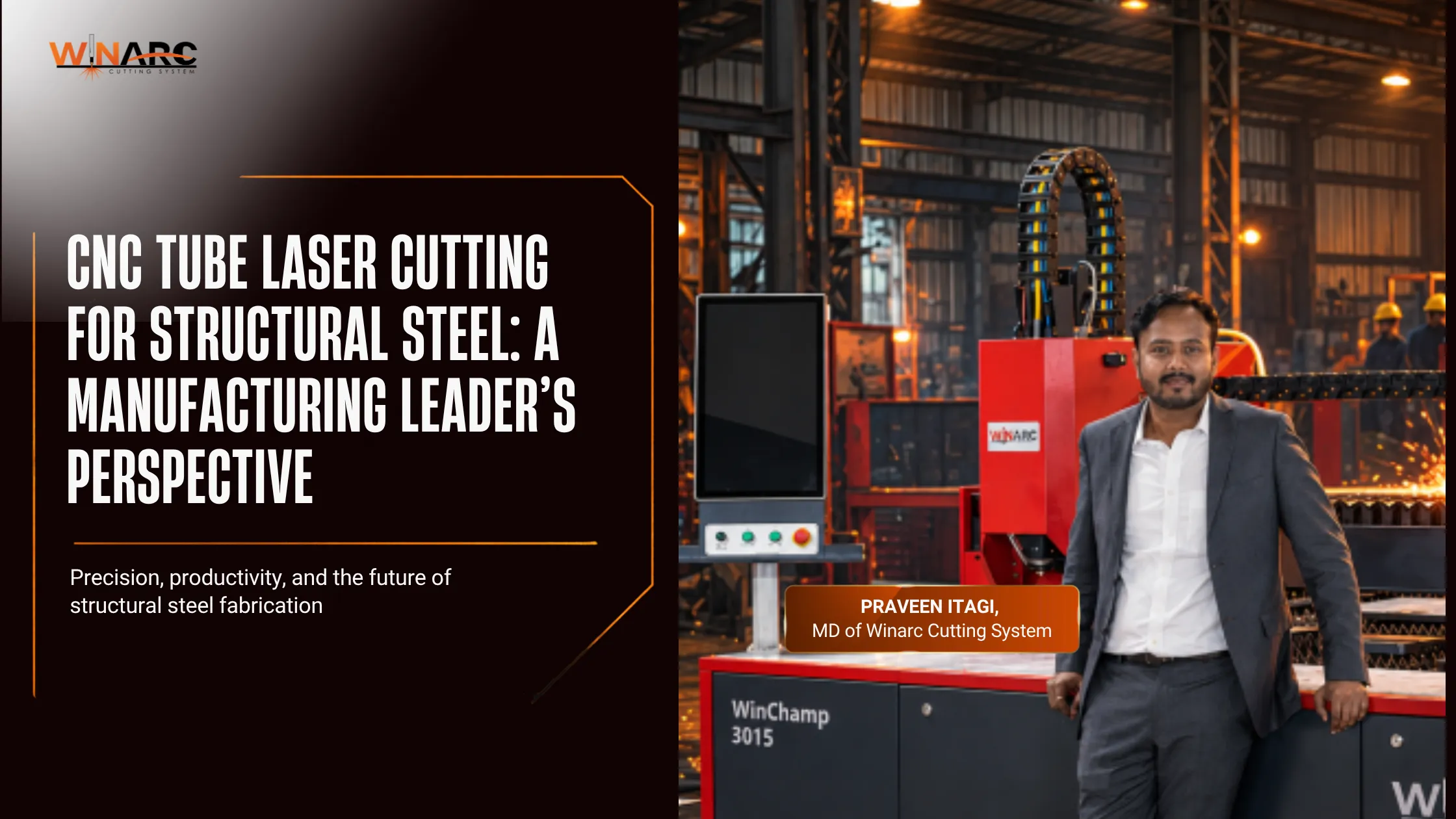
In my experience working with manufacturing businesses, technology delivers the greatest value when it addresses these challenges together. This is where CNC tube laser cutting for structural steel can make a meaningful difference.
At Winarc Cutting Systems, we believe the future of metal fabrication lies in combining the right technology with a clear understanding of real-world manufacturing requirements.
Why Structural Steel Fabrication Needs a Smarter Approach
Structural steel fabrication often involves multiple operations before a component is ready for assembly. Depending on the application, these may include measuring, marking, cutting, drilling, slotting, notching, grinding and fitting.
When these operations are performed separately, manufacturers may face several challenges:
- Longer production cycles: Multiple processing stages can increase the time required to complete a component.
- Inconsistent accuracy: Repeated manual measurements and handling can introduce variations.
- Higher material wastage: Cutting errors and inefficient material utilisation can increase scrap.
- Labour-intensive operations: Additional handling and secondary processing can consume valuable production time.
- Assembly difficulties: Inaccurate cuts and misaligned features can create challenges during fit-up and welding.
- Limited production flexibility: Changing designs or processing different section profiles may require additional setup and preparation.
These challenges can affect production efficiency, delivery schedules and overall manufacturing costs.
For businesses looking to scale their fabrication operations, improving the cutting process is an important step towards building a more efficient production system.
What Is CNC Tube Laser Cutting for Structural Steel?
CNC tube laser cutting uses computer-controlled motion and a laser cutting process to cut tube and compatible structural profiles according to programmed designs.
Depending on the machine configuration and supported material profiles, the technology can process components with features such as holes, slots, notches, angled cuts and other specified geometries.
Rather than relying entirely on separate manual operations, manufacturers can consolidate several cutting-related tasks into a more integrated workflow.
A suitable CNC tube laser cutting system can help process different structural profiles with repeatable accuracy, provided the material dimensions, machine configuration, cutting parameters and application requirements are within the system’s capabilities.
For structural steel fabricators, this can create opportunities to simplify production, improve consistency and reduce the amount of secondary processing required.
Learn more about Winarc’s solutions for tube processing and fabrication on our tube laser cutting machine manufacturers page.
Five Ways CNC Tube Laser Cutting Can Improve Structural Steel Fabrication
1. Improved Cutting Precision and Repeatability
In structural steel fabrication, accuracy is important long before a component reaches the assembly floor.
A hole that is incorrectly positioned, a slot with the wrong dimensions or a cut made at an incorrect angle can affect how components fit together. In demanding applications, these inconsistencies may lead to additional adjustment, rework and production delays.
CNC tube laser cutting allows cutting paths to be programmed and executed through computer-controlled motion. Once a suitable program and cutting setup have been established, the process can support consistent production across repeated components.
For manufacturers producing structural frames, supports, trusses and equipment structures, repeatability can help make downstream assembly more predictable.
The objective is not simply to achieve a precise cut. It is to create components that fit more consistently into the overall manufacturing process.
2. Reduced Secondary Processing
Traditional structural steel fabrication may require separate operations for cutting, drilling, slotting and creating other component features.
Each additional operation can introduce another setup, another handling step and another opportunity for variation.
Depending on the profile, drawing and machine capabilities, CNC tube laser cutting can combine multiple cutting features into a single programmed process.
This may reduce the need for separate drilling or notching operations and minimise manual intervention between production stages.
For manufacturers, fewer processing steps can translate into a simpler workflow and better use of available production capacity.
However, the level of consolidation depends on the component design and the capabilities of the selected machine. A manufacturing assessment should identify which operations can realistically be combined.
3. Better Material Utilisation and Scrap Control
Steel is a major input cost in structural fabrication. Even a small improvement in material utilisation can become significant when production volumes increase.
Material wastage can result from inefficient cutting plans, incorrect measurements, processing errors and components that cannot be used because they fail to meet dimensional requirements.
CNC-based processing can support more controlled cutting and repeatable execution of programmed designs. When combined with appropriate nesting or material-planning practices, it can also help manufacturers improve how components are arranged and cut from available stock.
The result can be better control over material consumption and reduced avoidable scrap.
From a management perspective, this is important because material utilisation directly influences manufacturing economics. A purchasing decision should therefore consider not only the machine’s cutting capability but also how it may affect material consumption across the production cycle.
The actual savings will depend on part geometry, material dimensions, nesting strategy, cutting parameters and production practices.
4. Higher Productivity Through Workflow Integration
Production efficiency is not determined by cutting speed alone.
A machine may cut quickly, but the overall manufacturing process can still be slow if loading, unloading, programming, material handling and secondary operations create bottlenecks.
This is why I believe manufacturers should evaluate CNC tube laser cutting as part of a complete production workflow rather than as an isolated piece of equipment.
The right solution should be assessed against factors such as:
- Time required to prepare and process a component.
- Frequency of material changes and machine setups.
- Number of secondary operations eliminated.
- Ease of handling different production requirements.
- Operator involvement throughout the process.
- Consistency of output across repeat orders.
By looking at the entire process, manufacturers can identify where automation and process integration are likely to deliver the greatest operational benefit.
The goal is to improve throughput without compromising the quality requirements of the finished component.
5. Greater Flexibility for Changing Design Requirements
Structural steel projects do not always follow identical production requirements. Different customers, building designs and industrial applications may require different profile dimensions, hole patterns, cut angles and component lengths.
With a suitable CNC tube laser cutting system, manufacturers can use programmed cutting paths to process different designs within the machine’s supported operating range.
This can make it easier to manage product variations and repeat jobs without depending entirely on manual marking and measurement.
For businesses serving multiple industries, this flexibility can support a wider range of fabrication requirements.
Before selecting a machine, manufacturers should verify the profile types, dimensions, material thicknesses, cutting features and tolerances required for their actual production mix.
Where Is CNC Tube Laser Cutting Used in Structural Steel?
The technology can support a range of applications involving compatible tubular and structural profiles.
Industrial Sheds and Warehouses
Industrial sheds and warehouses use structural members for frames, supports, roof structures and other components.
Accurate cutting and positioning of required features can help simplify component preparation and improve consistency during assembly.
Construction and Infrastructure
Certain construction and infrastructure applications require steel sections with precisely positioned holes, slots or connection features.
CNC tube laser cutting can support the preparation of these components when the profile, material and design fall within the machine’s capabilities.
Trusses and Structural Frameworks
Trusses and frameworks often contain multiple interconnected members. Consistent component dimensions and accurately prepared connection features can help reduce fit-up challenges during fabrication.
Industrial Equipment and Machinery Frames
Manufacturers of industrial equipment may use structural tubes and profiles to create machine frames, supports, guards and other assemblies.
CNC processing can help produce repeatable components while supporting different design requirements.
Agricultural and Material-Handling Equipment
Structural profiles are also used in agricultural machinery, handling systems, storage structures and equipment frames.
For these applications, the ability to process recurring components consistently can be valuable, particularly when production involves multiple part designs.
An important consideration: Not every structural section is suitable for every tube laser cutting machine. Manufacturers should confirm whether the machine supports their specific profiles, dimensions, material grades and processing requirements before making an investment.
How Should Manufacturers Choose the Right CNC Tube Laser Cutting Machine?
A machine purchase should begin with the manufacturer’s production requirements, not simply the machine’s headline specifications.
As I see it, the right investment is one that addresses current operational challenges while allowing the business to meet its anticipated production needs.
Here are six factors manufacturers should evaluate.
1. Profile Compatibility
Start by listing the structural sections used in your facility. These may include round tubes, square tubes, rectangular tubes and other compatible profiles.
Confirm the supported profile shapes, maximum dimensions, loading requirements and clamping arrangements of the machine.
2. Material and Thickness Requirements
Identify the material grades and thickness ranges processed regularly.
Ask the manufacturer to demonstrate cutting performance using representative samples from your actual production mix. Performance can vary according to material grade, thickness, profile geometry, cutting parameters and machine configuration.
3. Required Cutting Features
Review the drawings of your most common components.
Do they require holes, slots, notches, angled cuts or other specialised features? Can the proposed machine produce these features within the required tolerances?
A demonstration using actual component drawings can help establish whether the solution meets your needs.
4. Software and Programming Workflow
Programming is an important part of an efficient CNC operation.
Understand how the system handles part drawings, cutting programs, design changes and production preparation. Also consider operator training and the ease of integrating the software into your existing workflow.
5. Loading, Unloading and Material Handling
Material handling can have a significant effect on overall productivity.
Evaluate how raw material is loaded, how finished components are unloaded and how the machine fits into your factory layout. Where production volumes justify it, assess the benefits of suitable automation options.
6. Service, Training and Long-Term Support
A manufacturing machine is a long-term operational investment.
Beyond the initial purchase, consider installation, operator training, maintenance requirements, availability of technical support and access to consumables and spare parts.
The best solution is not necessarily the machine with the highest specification. It is the one that delivers the right balance of performance, reliability, operating cost and support for your application.
Explore the range of solutions available from Winarc on our Products page.
Understanding the Business Case: Look Beyond Cutting Speed
When evaluating CNC tube laser cutting for structural steel, I encourage manufacturers to assess the investment in terms of total production economics.
The relevant question is not simply, “How quickly can this machine cut a tube?”
A more useful set of questions would be:
- How much production time can be saved across the complete process?
- Which secondary operations can be reduced or eliminated?
- How much avoidable material wastage can be prevented?
- Will the new process reduce rework and improve component consistency?
- Can the machine help the business handle higher volumes or more complex orders?
- What will the operating and maintenance costs look like?
- How will the investment affect delivery performance and production planning?
These questions help connect machine capability with measurable business outcomes.
Manufacturers can start by documenting the time, material consumption, labour and rework associated with a representative set of existing components. They can then compare those figures with results from a controlled trial using the proposed technology.
This approach creates a more realistic basis for calculating the potential return on investment.
It also helps ensure that the technology selected is appropriate for the company’s actual needs rather than an assumed production scenario.
The Future of Structural Steel Fabrication Is About Integration
Manufacturing competitiveness increasingly depends on how effectively different stages of production work together.
Precision cutting is important, but it is only one part of the larger picture. Design preparation, programming, material utilisation, handling, assembly and quality control all influence the final outcome.
For structural steel fabricators, CNC tube laser cutting represents an opportunity to rethink how components move from drawing to finished part.
When the technology is matched to the application and supported by the right processes, it can help manufacturers pursue greater consistency, improved productivity and better control over production costs.
At Winarc Cutting Systems, our approach is to understand the challenges manufacturers face and help them evaluate solutions against their practical requirements. Every manufacturing business has its own combination of materials, products, production volumes and operational constraints. Those differences matter when selecting the right technology.
The next step towards a more efficient factory begins with understanding the process you have today—and identifying where precision, automation and integration can make a meaningful difference.
Watch CNC Laser Cutting Technology in Action
Understanding a machine’s capabilities becomes easier when you can see the cutting process in action.
Watch the video below to explore the technology and see how laser cutting can support modern metal fabrication.
Watch on YouTube: Winarc Cutting Systems – Laser Cutting Machine Video
Final Thoughts: Make Technology Work for Your Manufacturing Goals
As manufacturers plan their next stage of growth, investing in the right technology can help them strengthen production capabilities and respond more effectively to customer expectations.
CNC tube laser cutting for structural steel offers manufacturers a way to approach component preparation with greater precision, repeatability and process integration.
However, the value of any machine depends on how well it fits the application. Understanding your component designs, material requirements, production volumes and long-term business goals is essential before making an investment.
My recommendation is simple: evaluate the entire manufacturing process, identify the areas where improvement will have the greatest impact, and choose a solution based on measurable operational needs.
At Winarc Cutting Systems, we believe that informed technology decisions are an important foundation for sustainable manufacturing growth.
If you are exploring tube laser cutting for your structural steel fabrication requirements, connect with the Winarc team to discuss your application and identify a suitable solution.
Explore Winarc’s tube laser cutting solutions or browse our complete product range.