Steel fabrication is an essential part of modern industrial manufacturing. From structural steel frameworks and industrial platforms to machinery components and heavy-duty equipment, fabricated steel products are used across construction, infrastructure, engineering and manufacturing industries.
As fabrication requirements become more demanding, manufacturers need cutting solutions that can process steel plates efficiently, maintain dimensional consistency and support different component designs.
Traditional manual cutting methods can involve extensive marking, repeated measurements and additional finishing operations. These processes may increase production time and make it difficult to maintain consistent output across large production orders.
A CNC plasma cutting machine for steel fabrication offers a practical solution for manufacturers looking to automate metal plate cutting and improve production efficiency.
CNC plasma cutting combines a plasma arc with computer-controlled movement to cut electrically conductive metals along programmed paths. It is widely used in steel fabrication applications where cutting capacity, flexibility and production economics are important.
In this guide, we will explore how CNC plasma cutting supports steel fabrication, the important machine features to consider, its industrial applications and how manufacturers can choose the right cutting solution for their production requirements.
Why CNC Plasma Cutting Is Important in Steel Fabrication
Steel fabrication involves converting raw steel plates and sections into components that are used in larger structures or finished products.
These components may include:
- Structural steel plates
- Mounting brackets
- Base plates
- Reinforcement plates
- Machine frames
- Support structures
- Industrial platforms
- Fabricated equipment components
Many of these parts require cutting operations before they can be welded, drilled, machined or assembled.
A CNC steel cutting machine helps automate this process by following programmed cutting paths generated from engineering drawings.
This can help manufacturers improve workflow consistency, reduce manual cutting requirements and simplify repeat production jobs.
CNC plasma cutting is particularly relevant for steel fabrication businesses that process a variety of plate components and require a flexible cutting system.
1. CNC Plasma Cutting Machine for Steel Fabrication
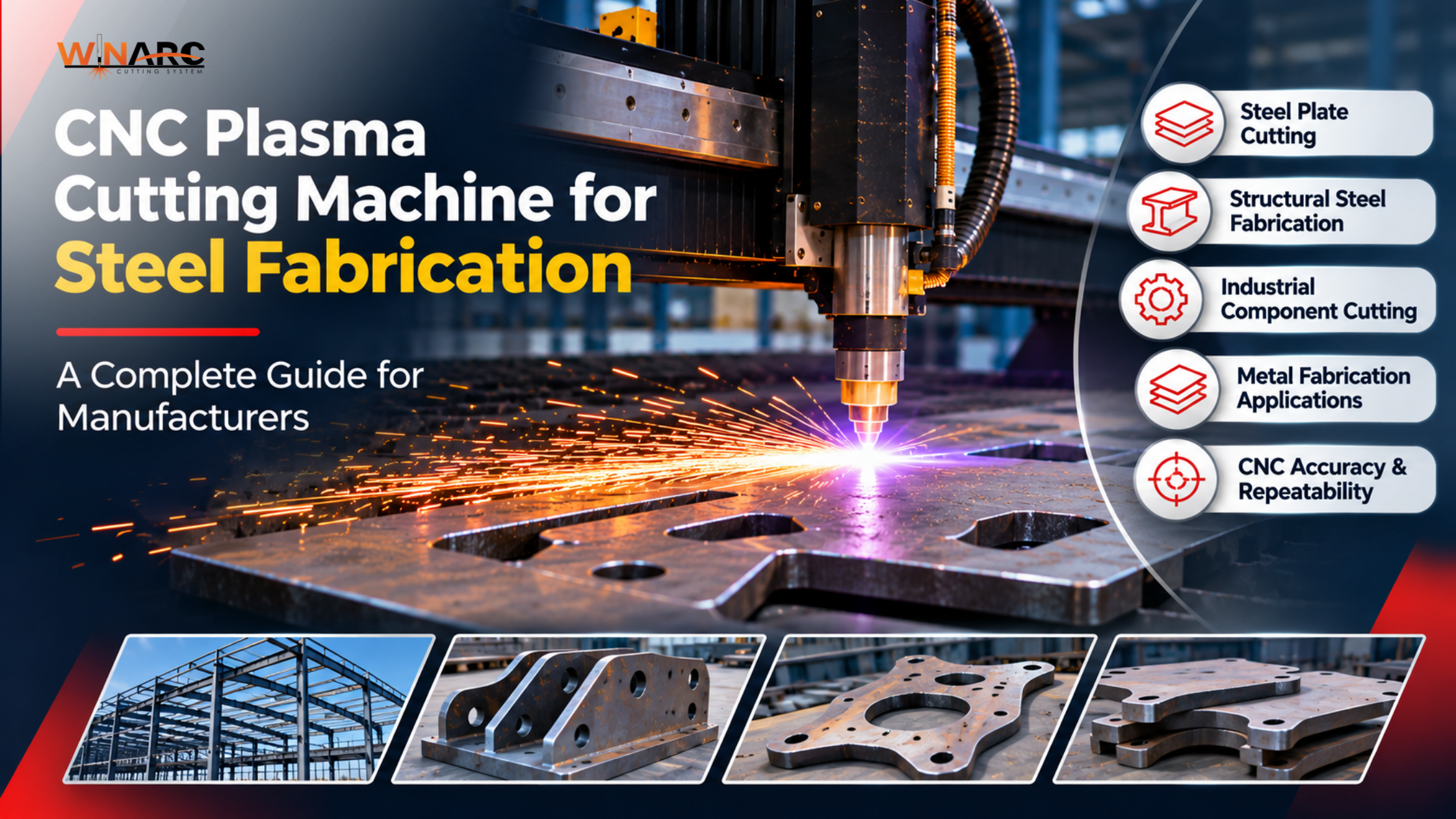
A CNC plasma cutting machine for steel fabrication uses a plasma arc to melt metal along a programmed cutting path. A high-velocity gas stream removes the molten material from the cut.
The CNC controller guides the torch according to the component design, allowing manufacturers to cut different shapes and profiles from steel plates.
This technology is commonly used for cutting:
- Mild steel plates
- Structural steel components
- Fabricated brackets
- Industrial support plates
- Heavy machinery components
- Construction steel parts
Plasma cutting is suitable for electrically conductive metals, including mild steel, stainless steel and aluminium, when supported by the selected plasma power source and machine configuration.
For steel fabrication manufacturers, one of the key advantages is the ability to process different component designs without creating a separate physical cutting template for every job.
Why it matters: CNC plasma cutting helps fabrication businesses automate plate processing and produce repeatable components using digital cutting programs.
2. Steel Plate Plasma Cutting Machine: What Should You Look For?
A steel plate plasma cutting machine should be selected according to the material grade, plate thickness, working area and production requirements.
Not all plasma cutting machines offer the same cutting capacity or performance. Manufacturers should evaluate the complete machine system before making an investment.
Cutting Capacity
Check the machine’s rated cutting and piercing capacity for the steel thicknesses you regularly process.
Piercing capacity and edge-start cutting capacity may differ. Always confirm the manufacturer’s specifications for the material grade and thickness you intend to cut.
Working Area
The cutting table should accommodate the plate dimensions used in your production facility.
A suitable working area can reduce the need to divide large components into smaller sections before cutting.
Torch Height Control
Torch height control helps maintain an appropriate distance between the plasma torch and the steel plate.
This is important because plate surfaces may not always be perfectly flat. Maintaining suitable torch height supports more consistent cutting conditions.
Machine Construction
A machine intended for industrial steel fabrication should have a structure designed for stable operation.
Evaluate the frame, guide rails, drive system and mechanical components according to the working area and production environment.
CNC Controller
The CNC controller should support reliable motion control and execute programmed cutting paths accurately.
Manufacturers should also evaluate the ease of programming, operator interface and compatibility with their CAD/CAM workflow.
Practical tip: Share sample steel plate drawings with the machine supplier and request a cutting demonstration using your actual material thickness.
3. CNC Steel Cutting Machine for Different Fabrication Applications
A CNC steel cutting machine can support a wide range of manufacturing and fabrication activities.
Depending on the machine configuration, manufacturers can use CNC plasma cutting for components such as:
- Steel brackets
- Machine base plates
- Structural supports
- Reinforcement sections
- Industrial frames
- Fabricated enclosures
- Equipment mounting plates
CNC programming allows component designs to be stored and reused for repeat production.
This is particularly useful for fabrication businesses that manufacture similar components for multiple projects.
For example, a manufacturer producing industrial platforms may need different support plates, mounting brackets and reinforcement components for each project. CNC cutting allows these designs to be programmed and processed according to the required dimensions.
Manufacturing advantage: Digital cutting programs help reduce dependence on repeated manual marking and support more consistent production planning.
4. Plasma Cutter for Metal Fabrication: Key Industrial Applications
A plasma cutter for metal fabrication is used across several industries where conductive metal plates need to be cut into components.
Structural Steel Fabrication
Structural fabrication companies process steel plates and sections used in buildings, industrial structures, platforms and infrastructure projects.
CNC plasma cutting can support the production of compatible plate components such as gussets, base plates, brackets and connection plates.
Heavy Equipment Manufacturing
Manufacturers of construction machinery, agricultural equipment and industrial machinery often use fabricated steel components.
Plasma cutting can be considered for compatible plate parts, reinforcement components and structural supports.
Industrial Machinery Manufacturing
Machine builders use steel plates to manufacture frames, bases, mounting structures and other fabricated components.
CNC cutting helps process these parts according to engineering drawings.
Construction and Infrastructure
Fabricators working on industrial sheds, bridges, platforms and infrastructure projects may need to cut different steel plate profiles.
A CNC plasma system can support these operations when the material thickness and required cutting quality are within the machine’s capability.
General Metal Fabrication
Job shops often process different component designs for multiple customers.
CNC plasma cutting provides flexibility for producing a wide range of compatible steel components without requiring a dedicated cutting template for every part.
5. Structural Steel Cutting Machine for Fabrication Projects
A structural steel cutting machine is used to process steel components that form part of larger structures.
These components may include:
- Base plates
- Gusset plates
- Connection plates
- Support brackets
- Reinforcement plates
- Structural machine components
Structural steel fabrication often involves components that must fit accurately during welding and assembly.
The cutting process therefore needs to maintain the required dimensions and edge quality.
CNC plasma cutting can be suitable for many structural plate applications, depending on the required tolerances and material thickness.
For applications requiring very fine details or tighter dimensional tolerances, manufacturers may need to evaluate fiber laser cutting or other suitable technologies.
Important: Cutting is only one stage of structural fabrication. Components may also require deburring, machining, inspection or other finishing operations depending on the design and quality requirements.
6. Important Features of a Professional CNC Plasma Cutting Machine
When selecting a CNC plasma cutting system for steel fabrication, manufacturers should consider the complete machine configuration.
CNC Motion Control
The CNC controller coordinates the movement of the cutting torch along the programmed path.
Reliable motion control is important for producing consistent component profiles and repeatable cutting results.
Plasma Torch Height Controller
Automatic torch height control helps maintain a suitable torch-to-workpiece distance during cutting.
This supports more consistent cutting conditions when plate surfaces vary.
Torch Collision Protection
Torch collision protection helps reduce the risk of damage if the torch encounters an obstacle or a raised component.
This is useful when cutting complex layouts containing multiple parts and cutouts.
Suitable Drive System
The drive system controls the movement of the cutting machine.
Manufacturers should evaluate the motors, drives, transmission components and mechanical structure according to the machine’s working area and production requirements.
CAD/CAM and Nesting Software
Nesting software arranges component designs on a steel plate to improve material utilisation.
A suitable software workflow can help reduce unnecessary gaps between parts, optimise cutting layouts and simplify job preparation.
Safety Provisions
Industrial plasma cutting involves high temperatures, electrical equipment, fumes and intense light.
The machine installation should include suitable safety provisions, operator training, fume management and protective equipment based on the cutting process and factory environment.
After-Sales Support
Installation, commissioning, operator training, maintenance guidance and spare parts availability are important when selecting a machine for regular production.
7. CNC Plasma Cutting vs. Fiber Laser Cutting vs. Oxy-Fuel Cutting
Steel fabrication businesses may use different cutting technologies depending on their material thickness, component geometry and production requirements.
| Parameter | CNC Plasma | Fiber Laser | Oxy-Fuel |
|---|---|---|---|
| Cutting method | Plasma arc | Focused laser beam | Fuel gas and oxygen |
| Material compatibility | Electrically conductive metals | Metals supported by the laser system | Primarily suitable ferrous materials |
| Common applications | Plate and structural fabrication | Precision sheet and plate cutting | Thick carbon steel cutting |
| Cutting detail | Suitable for many industrial profiles | Generally suited to finer details | Generally suited to less intricate profiles |
| Thickness capability | Depends on plasma source | Depends on laser power and material | Suitable for very thick carbon steel |
| Typical consideration | Cutting capacity and process economics | Precision and edge quality | Material compatibility and thickness |
When Is CNC Plasma Cutting a Suitable Choice?
CNC plasma cutting is worth considering when your production involves conductive steel plates and you need a flexible cutting solution for industrial fabrication.
It is commonly evaluated for applications where cutting capacity, production volume and operating economics are important.
When Should You Consider Fiber Laser Cutting?
Fiber laser cutting may be more suitable when manufacturers require finer details, narrower kerf and higher precision on compatible material thicknesses.
It is often considered for sheet metal components, precision brackets and detailed profiles.
When Is Oxy-Fuel Cutting Appropriate?
Oxy-fuel cutting is commonly used for thick carbon steel plates where the required thickness may exceed the practical capacity of the selected plasma or laser system.
It is not suitable for all metals and is primarily used for compatible ferrous materials.
The best cutting technology should be selected according to actual production requirements rather than a single machine specification.
8. How to Improve Productivity in Steel Plate Cutting
Investing in a CNC cutting machine is only one part of improving fabrication productivity.
Manufacturers can also optimise the surrounding production process.
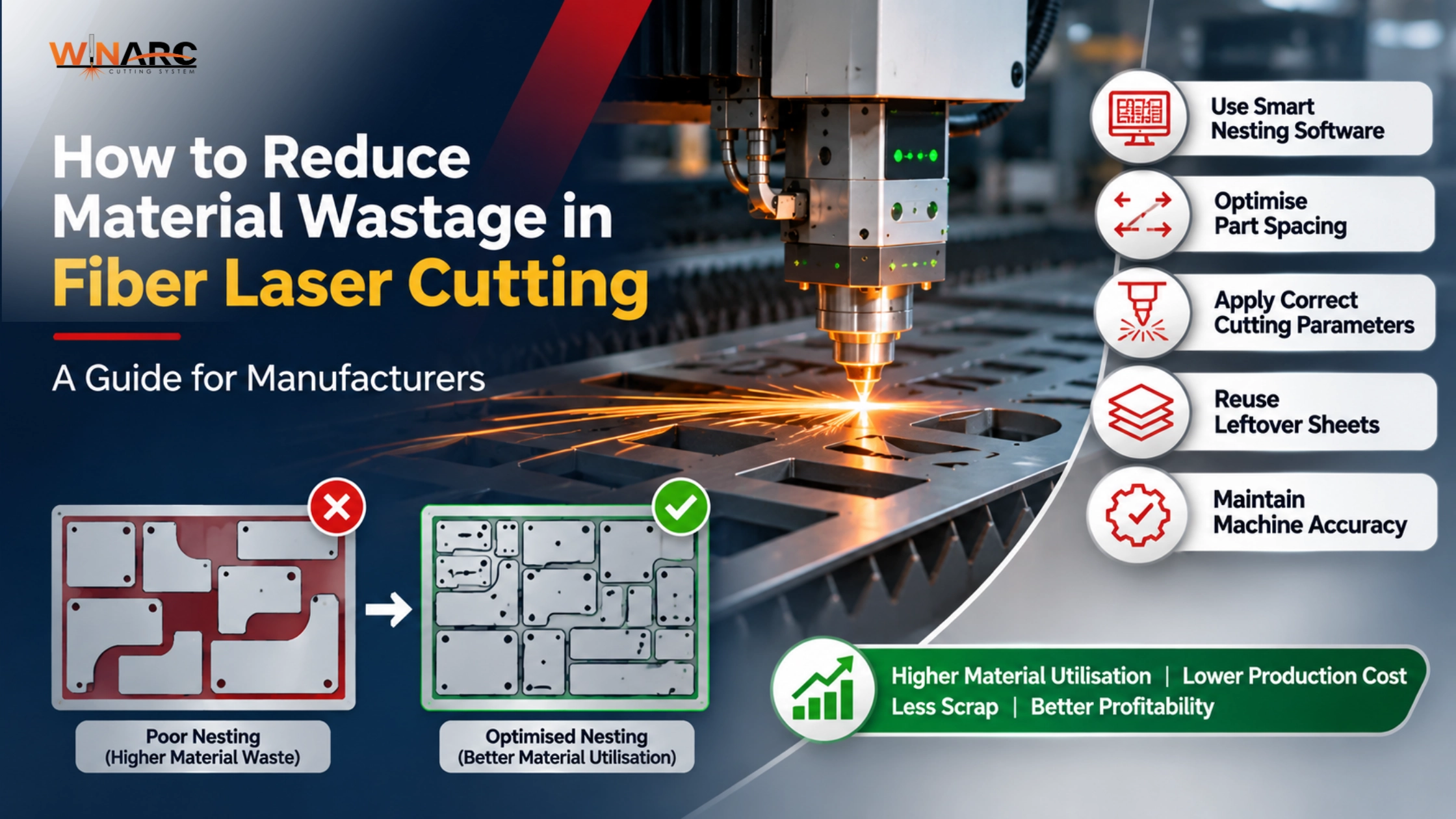
Use Efficient Nesting Layouts
Arrange component designs on the plate to minimise unused space while maintaining suitable cutting clearances.
Efficient nesting can help reduce raw material consumption and improve the number of components produced from each sheet.
Standardise Cutting Parameters
Maintain validated cutting parameters for frequently processed material grades and thicknesses.
This helps reduce trial-and-error adjustments and supports consistent production.
Maintain the Cutting Torch
Inspect consumables and torch components regularly.
Worn or damaged consumables can affect cutting quality and increase the likelihood of rejected parts.
Train CNC Operators
Operators should understand programming, cutting parameters, machine safety and basic troubleshooting.
Good operator practices help reduce avoidable errors and improve production consistency.
Track Production Data
Monitor material consumption, cutting time, scrap generation and rejected components.
Production data helps identify recurring problems and opportunities for improvement.
9. How to Choose the Right CNC Plasma Cutting Machine for Your Factory
Before purchasing a CNC plasma cutting machine, evaluate your current and future fabrication requirements.
Use this checklist:
| Evaluation Factor | What to Verify |
|---|---|
| Material type | Mild steel, stainless steel or aluminium |
| Material thickness | Rated cutting and piercing capacity |
| Plate dimensions | Maximum working area |
| Component geometry | Required profiles, holes and cutouts |
| Cutting accuracy | Required dimensional tolerances |
| Production volume | Components required per shift |
| CNC controller | Programming and motion control |
| Torch height control | Automatic height adjustment |
| Nesting software | Material utilisation and workflow |
| Safety | Fume management and operator protection |
| Service support | Installation, training and spare parts |
It is also advisable to request a live demonstration using your own component drawings.
This will help you evaluate cutting performance, edge quality, production workflow and the suitability of the machine for your actual applications.
10. WINPLUS by Winarc: CNC Plasma Cutting for Steel Fabrication
Winarc Cutting Systems is a CNC cutting machine manufacturer based in Peenya Industrial Area, Bengaluru, India.
The company’s product portfolio includes cutting solutions for different metal fabrication requirements.
WINPLUS – High-Definition CNC Plasma Cutting Machine
WINPLUS is Winarc’s CNC plasma cutting machine, designed for industrial metal cutting applications.
According to Winarc’s product information, WINPLUS combines CNC controls with plasma cutting technology to support efficient and reliable metal cutting.
The machine is positioned for manufacturers looking for a plasma cutting solution for compatible metal plate applications.
For steel fabrication businesses, the right machine configuration should be selected according to:
- Material grade
- Plate thickness
- Working area
- Required cutting quality
- Production volume
- Component geometry
Winarc also offers other CNC cutting technologies, including fiber laser and oxy-fuel cutting machines, for different material and application requirements.
Explore the Winarc CNC cutting machine range to understand the available solutions for your fabrication operations.
Final Thoughts
Steel fabrication requires reliable cutting processes that can support the production of structural components, machinery parts and industrial assemblies.
A CNC plasma cutting machine for steel fabrication can be a valuable solution for manufacturers working with compatible steel plates and industrial cutting applications.
However, selecting the right machine requires more than comparing plasma power or advertised cutting speed.
Manufacturers should evaluate cutting capacity, working area, CNC control, torch height management, machine construction, safety and after-sales support.
When combined with suitable nesting software, trained operators and efficient production planning, CNC plasma cutting can help fabrication businesses improve workflow consistency and strengthen their manufacturing capabilities.
Looking for a CNC plasma cutting solution for your steel fabrication business?
Connect with Winarc to discuss your material specifications, plate dimensions and production requirements.
Visit: https://winarc.in/
Explore products: https://winarc.in/products/