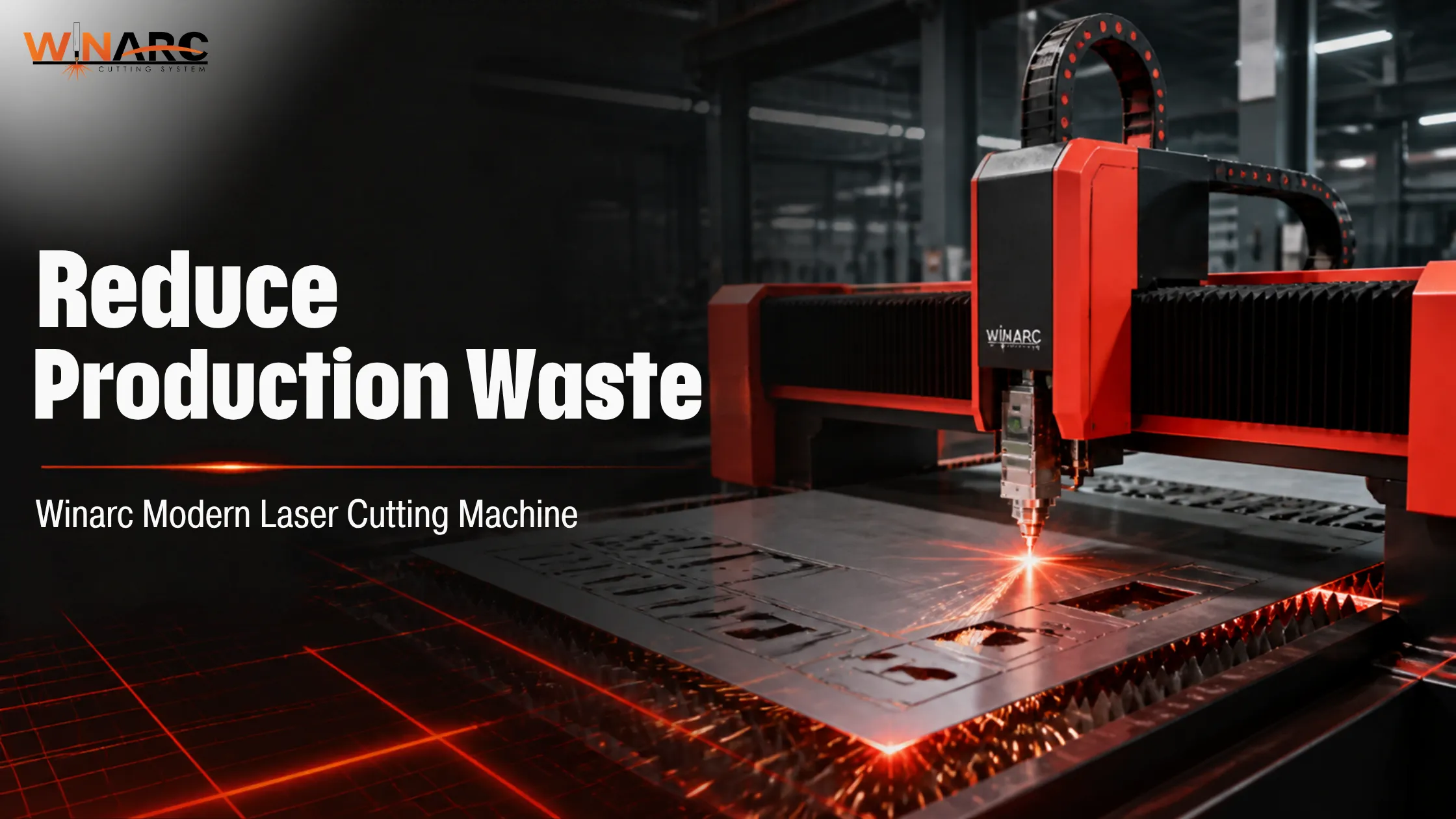
In metal fabrication, raw material is one of the biggest contributors to overall production costs. Even a small percentage of material wastage across hundreds or thousands of cutting jobs can significantly affect a manufacturer’s profitability.
For businesses using CNC fiber laser cutting machines, improving material utilisation is not just about purchasing better equipment. It involves optimising cutting layouts, selecting the right parameters, managing leftover sheets, maintaining machine accuracy and improving production planning.
This is where fiber laser cutting material wastage reduction becomes an important part of manufacturing efficiency.
Modern fiber laser cutting technology offers manufacturers excellent precision, repeatability and flexibility. However, without proper planning and process optimisation, even an advanced laser cutting machine can generate unnecessary scrap.
In this guide, we will explore practical strategies manufacturers can implement to reduce material wastage in fiber laser cutting, improve sheet utilisation and achieve better production economics.
What Is Material Wastage in Fiber Laser Cutting?
Material wastage refers to the portion of raw material that cannot be converted into usable finished components during the cutting process.
In CNC fiber laser cutting, wastage can occur due to several reasons:
- Poor part nesting and inefficient cutting layouts
- Excessive spacing between components
- Incorrect cutting parameters
- Improper kerf compensation
- Unusable leftover sheet material
- Poor-quality or damaged raw material
- Incorrect measurements and programming errors
- Machine calibration and alignment issues
- Excessive scrap caused by rejected components
Some material loss is unavoidable because the laser needs to remove material along the cutting path. However, manufacturers can control many other sources of wastage through better planning and process management.
10 Effective Ways to Reduce Material Wastage in Fiber Laser Cutting
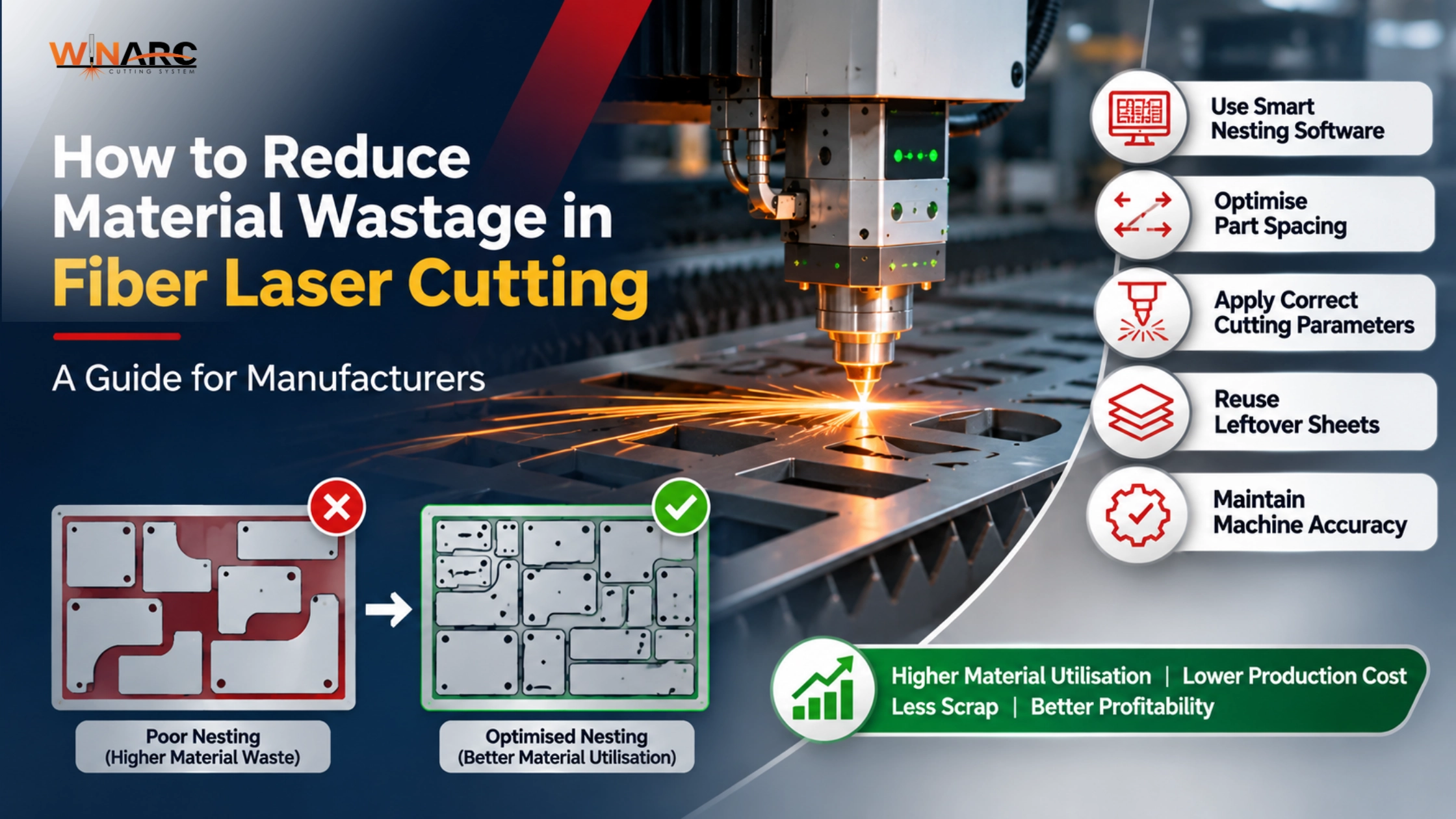
1. Use Smart Nesting Software to Optimise Sheet Utilisation
One of the most effective methods for fiber laser cutting material wastage reduction is using intelligent nesting software.
Nesting refers to arranging multiple component designs on a single metal sheet in a way that minimises unused space.
Manual nesting can leave unnecessary gaps between components, resulting in lower material utilisation. Smart nesting software analyses component shapes, dimensions and cutting requirements to generate optimised layouts.
Benefits of smart nesting include:
- Better utilisation of available sheet area
- Reduced unused spaces between components
- Improved production planning
- Lower raw material consumption
- Reduced scrap generation
- More efficient cutting operations
Manufacturers can explore professional CAD/CAM nesting solutions such as CypNest, Radan and SigmaNEST, depending on their machine compatibility and workflow requirements.
For example, Winarc supports smart nesting software options such as CypNest, Radan and SigmaNEST to help manufacturers optimise material utilisation.
Practical tip: Instead of nesting every job individually, evaluate whether compatible orders can be combined on a single sheet. This can improve utilisation, particularly when processing multiple small components.
2. Optimise Component Spacing and Cutting Layouts
Even when nesting software is used, component spacing needs to be configured correctly.
If the distance between components is unnecessarily large, valuable sheet area is wasted. However, placing components too close together can create cutting problems, thermal distortion or part instability.
The objective is to maintain the minimum practical spacing required for safe and accurate cutting.
Consider the following factors:
- Material thickness
- Kerf width
- Heat generation
- Part geometry
- Cutting sequence
- Component stability
- Removal and handling requirements
The ideal spacing is not identical for every job. It should be established through suitable software settings and production trials.
Practical tip: Review frequently manufactured components and standardise suitable spacing rules for recurring material types and thicknesses.
3. Understand Kerf Width and Apply Correct Compensation
Kerf refers to the width of material removed by the laser during cutting.
Although fiber laser cutting produces a relatively narrow cutting kerf, it still removes material along every cutting path. Incorrect kerf compensation can also affect component dimensions and lead to rejected parts.
For example, if the cutting program does not account for the actual kerf, a component may end up slightly smaller or larger than its required dimensions.
To manage kerf effectively:
- Establish appropriate cutting parameters for each material and thickness.
- Use the correct nozzle and focus settings.
- Calibrate kerf compensation through test cuts.
- Check dimensional accuracy using measuring instruments.
- Maintain consistent process parameters for repeat production jobs.
Why it matters: Correct kerf compensation helps maintain component dimensions and reduces material loss caused by rejected or incorrectly sized parts.
4. Select the Right Cutting Parameters for Every Material
Cutting parameters have a direct impact on cutting quality and production consistency.
Using incorrect laser power, cutting speed, focus position, nozzle selection or assist gas pressure can result in poor edges, excessive burrs, incomplete cuts and rejected components.
The ideal settings depend on several factors, including:
- Material type
- Material thickness
- Laser power
- Cutting speed
- Assist gas
- Nozzle diameter
- Focus position
- Cutting head condition
For example, mild steel, stainless steel and aluminium require different cutting conditions. Even two sheets of the same material may behave differently depending on their thickness, surface condition and quality.
Manufacturers should use validated cutting parameter libraries and conduct test cuts when processing a new material or thickness.
Practical tip: Maintain a standard cutting parameter database for frequently processed materials. This reduces trial-and-error adjustments and helps maintain consistent production quality.
5. Improve Cutting Sequence to Reduce Heat Distortion
The order in which components are cut can influence material behaviour during the cutting process.
When several components are positioned close together, excessive heat concentration in one area may cause local thermal distortion. This can affect dimensional accuracy, particularly when processing thin sheets or complex component geometries.
An optimised cutting sequence can help distribute heat more effectively.
Consider:
- Avoiding excessive consecutive cutting in one small area.
- Using suitable cutting sequences for complex layouts.
- Maintaining appropriate spacing between components.
- Applying suitable micro-joints where required.
- Reviewing the cutting path before production.
Advanced CNC software can help plan and optimise cutting sequences based on job requirements.
Why it matters: Better heat management helps reduce distortion-related defects and improves the probability of producing usable components.
6. Use Common-Line Cutting Where Appropriate
Common-line cutting is a nesting technique in which adjacent components share a cutting boundary.
Instead of cutting the same boundary separately for two components, the machine uses a shared cutting line where the component geometry and process conditions allow it.
This can help reduce:
- Total cutting path length
- Number of cutting operations
- Cycle time
- Material loss between certain components
However, common-line cutting is not suitable for every component or material.
It must be evaluated carefully based on component geometry, dimensional tolerances, heat effects, part stability and cutting software capabilities.
Practical tip: Identify recurring component designs that can be arranged with shared boundaries. Test the arrangement before introducing it into regular production.
7. Reuse Leftover Sheet Material and Maintain Remnant Records
Not every leftover portion of a metal sheet needs to become scrap.
After a cutting job is completed, usable sections of the remaining sheet can often be retained for future production.
However, many manufacturers discard these remnants because they do not have a systematic method to identify, measure and reuse them.
A structured remnant management process can help.
For every reusable leftover sheet, record:
- Material grade
- Sheet thickness
- Remaining dimensions
- Available usable area
- Storage location
- Date of storage
- Previous job reference
This information helps production planners identify suitable remnants before ordering new sheets.
Example: If a production job leaves a usable rectangular section of a stainless steel sheet, that section may be suitable for smaller brackets, plates or other components in a future order.
Why it matters: Reusing suitable remnants reduces unnecessary raw material purchases and improves overall material utilisation.
8. Maintain Machine Accuracy and Cutting Head Condition
Machine maintenance plays an important role in reducing rejected components and material wastage.
Over time, worn or damaged components, improper alignment, contamination and incorrect calibration can affect cutting consistency.
A poorly maintained cutting head may produce inconsistent results, resulting in burrs, incomplete cuts and poor edge quality.
Manufacturers should regularly inspect:
- Cutting head and protective lenses
- Nozzles and nozzle alignment
- Focus position
- Linear guides and transmission components
- Servo drive performance
- Machine calibration
- Cooling system
- Lubrication system
Preventive maintenance is generally more economical than allowing small machine issues to develop into production defects or unplanned downtime.
Practical tip: Maintain a preventive maintenance checklist and document recurring cutting-quality issues. This helps identify whether defects are related to machine condition, material quality or process parameters.
9. Improve Raw Material Quality and Storage Practices
Material wastage does not always originate from the cutting process. Sometimes the problem begins before the sheet reaches the machine.
Poor-quality or improperly stored metal sheets can have surface contamination, corrosion, scratches, warping or inconsistent dimensions.
These issues can affect cutting performance and increase the likelihood of rejected components.
To minimise such problems:
- Purchase sheets from reliable suppliers.
- Inspect material before accepting it.
- Verify material grade and thickness.
- Store sheets in a dry and organised environment.
- Avoid unnecessary handling damage.
- Separate different grades and thicknesses.
- Use suitable lifting and material handling equipment.
For manufacturers working with multiple materials, proper inventory management also prevents incorrect material selection during production.
Why it matters: Consistent raw material quality supports predictable cutting performance and reduces avoidable rejection.
10. Monitor Material Utilisation and Track Scrap Percentage
One of the most overlooked strategies for fiber laser cutting material wastage reduction is measuring actual material utilisation.
Without data, manufacturers may know that scrap is being generated but may not understand where the losses are occurring.
Start tracking a few basic production metrics:
- Total raw material consumed
- Total finished component weight
- Reusable leftover material
- Unusable scrap
- Rejected components
- Material utilisation percentage
- Material cost per finished component
A simple material utilisation formula is:
Material Utilisation (%) = (Usable Component Material ÷ Total Raw Material Consumed) × 100
For example:
If a manufacturer uses 100 kg of sheet metal and produces components weighing 85 kg, the material utilisation is:
85 ÷ 100 × 100 = 85%
The remaining 15 kg represents material that has not become usable finished components. It may include cutting kerf, scrap skeletons, reusable remnants and process-related losses.
It is important to distinguish between reusable remnants and actual unusable scrap when evaluating performance.
Practical tip: Track material utilisation by material grade, thickness, component type and production order. This helps identify which jobs need better nesting or process optimisation.
How Does Fiber Laser Cutting Technology Help Reduce Material Wastage?
Fiber laser cutting machines combine precision motion control, CNC programming and concentrated laser energy to process metal sheets with accuracy.
When configured and operated correctly, these capabilities can help manufacturers reduce avoidable material loss.
Here are some of the important advantages:
High Cutting Precision
Accurate positioning and consistent motion help produce components according to programmed dimensions. This reduces the possibility of dimensional errors and rework.
Narrow Cutting Kerf
Fiber laser cutting generally produces a narrow kerf, helping manufacturers arrange components efficiently and reduce material removed along the cutting path.
Actual kerf width depends on the material, thickness, laser settings and cutting conditions.
Smart Nesting Integration
Compatible nesting software can optimise the arrangement of multiple component designs on a single sheet, reducing unnecessary gaps and improving material utilisation.
Consistent Production Quality
A properly maintained machine with validated cutting parameters can help maintain consistent output across repeat production jobs.
Flexible Material Processing
Fiber laser technology can process materials such as mild steel, stainless steel and aluminium, subject to the machine’s laser power and material thickness capabilities.
Together, these capabilities provide manufacturers with opportunities to improve productivity and control material costs.
Example: How Material Wastage Reduction Can Improve Manufacturing Costs
Consider a manufacturer that processes 100 metal sheets every month.
Assume the following:
- Average sheet cost: ₹5,000
- Monthly sheet consumption: 100
- Total monthly raw material cost: ₹5,00,000
- Current material utilisation: 80%
If improved nesting and production planning increase material utilisation to 85%, the business can produce more usable component material from the same quantity of raw material.
For an illustrative comparison, assume the manufacturer maintains the same monthly finished-component output and that the material utilisation improvement translates proportionally into lower raw material requirements.
| Parameter | Before Optimisation | After Optimisation |
|---|---|---|
| Material utilisation | 80% | 85% |
| Finished-component output | Same | Same |
| Monthly raw material requirement | 100 sheets | 94.12 sheets |
| Cost per sheet | ₹5,000 | ₹5,000 |
| Estimated monthly material cost | ₹5,00,000 | ₹4,70,588 |
| Estimated monthly savings | — | ₹29,412 |
Estimated annual savings: ₹3,52,944
This is an illustrative calculation, not a guaranteed saving. Actual results depend on component geometry, sheet sizes, nesting efficiency, remnant reuse, material quality and production conditions.
The key takeaway is that even a modest improvement in material utilisation can create meaningful savings when repeated across regular production volumes.
Common Mistakes Manufacturers Should Avoid
While implementing material wastage reduction strategies, manufacturers should watch out for these common mistakes:
- Depending entirely on manual nesting: Manual layouts may not utilise sheet area as efficiently as suitable nesting software.
- Ignoring kerf compensation: Incorrect compensation can lead to dimensional inaccuracies and rejected parts.
- Using the same cutting parameters for every material: Different materials and thicknesses require appropriate settings.
- Discarding all leftover sheets: Some remnants may be suitable for future production.
- Ignoring preventive maintenance: Poor machine condition can increase defects and rework.
- Not tracking scrap percentage: Without production data, it is difficult to identify recurring material losses.
- Over-optimising component spacing: Extremely tight layouts can create thermal, handling or part stability issues.
- Ignoring operator training: Incorrect programming and machine operation can increase avoidable production losses.
Reducing material wastage requires a combination of technology, process discipline and continuous improvement.
How to Choose a Fiber Laser Cutting Machine for Better Material Utilisation
If you are planning to invest in a new CNC fiber laser cutting machine, material utilisation should be one of your evaluation criteria.
Instead of focusing only on laser power or cutting speed, consider the complete production system.
Here are some important features to evaluate:
| Machine Feature | How It Helps |
|---|---|
| Compatible nesting software | Optimises component placement on metal sheets |
| High positioning accuracy | Helps maintain dimensional consistency |
| Reliable CNC controller | Supports accurate and repeatable cutting operations |
| Stable machine construction | Helps maintain consistent cutting performance |
| Quality cutting head | Supports reliable focus and cutting quality |
| Automatic lubrication | Helps reduce maintenance-related interruptions |
| Suitable fume extraction | Supports a cleaner working environment |
| Technical support | Helps resolve production and maintenance issues |
Winarc’s CNC fiber laser cutting machine range includes models designed for different manufacturing requirements, including WINCHAMP single-pallet machines, WINMASTER dual-pallet machines, WINPRO gantry machines and WINHYBRID plate-and-tube machines.
The company also lists CypNest, Radan and SigmaNEST among its CAD/CAM nesting software options for improving material utilisation.
The right machine configuration should be selected based on your sheet dimensions, material thickness, production volume and component requirements.
Why Choose Winarc for CNC Fiber Laser Cutting Solutions?
Winarc Cutting Systems is a CNC cutting machine manufacturer based in Peenya, Bengaluru, India.
The company provides fiber laser cutting solutions designed for manufacturers across different industrial applications.
Its product range includes:
- WINMASTER: Dual-pallet CNC fiber laser cutting machine designed for high-volume production.
- WINCHAMP: Single-pallet fiber laser cutting machine for general metal fabrication requirements.
- WINPRO: Gantry-type fiber laser cutting machine for large-format and heavy fabrication applications.
- WINHYBRID: Plate-and-tube combination machine for manufacturers working with different metal profiles.
Winarc’s machine solutions incorporate CNC control systems, precision motion components and compatible software options to support accurate and efficient metal cutting.
By combining suitable machine configuration, nesting software and process optimisation, manufacturers can work towards better material utilisation and lower production costs.
Explore the Winarc CNC fiber laser cutting machine range to understand the available solutions for your factory.
Final Thoughts: Make Every Metal Sheet Count
Material wastage directly affects manufacturing costs, production efficiency and profitability.
For businesses operating CNC fiber laser cutting machines, reducing material loss should be treated as an ongoing production improvement initiative rather than a one-time exercise.
Smart nesting, correct kerf compensation, optimised cutting parameters, remnant management, preventive maintenance and production monitoring can collectively improve material utilisation.
Investing in the right fiber laser cutting technology is an important part of this process. However, the best results come when advanced machinery is supported by skilled operators, efficient programming and disciplined production planning.
At Winarc, we believe that manufacturing efficiency starts with the right cutting solution.
Looking to improve material utilisation in your factory?
Connect with Winarc to discuss your metal cutting requirements and explore a suitable CNC fiber laser cutting machine for your production operations.
Visit: https://winarc.in/
Explore products: https://winarc.in/products/