Every year, metal fabricators across India invest lakhs of rupees in buying a fiber laser cutting machine, only to discover months later that the machine is wrong for their production, the supplier has disappeared, or the running costs are far higher than the brochure suggested.
These are not rare stories. They are the most common outcomes when buyers rush the decision, focus only on the headline price, or trust a supplier’s claims without asking the right questions.
Buying a fiber laser cutting machine is one of the most significant capital investments a manufacturing business makes. Done right, it transforms production capacity, cut quality, and profit margins. Done wrong, it locks your business into years of underperformance, inflated operating costs, and zero after-sales support.
At Winarc, we have spoken with hundreds of metal fabricators across India who are evaluating fiber laser cutting machines. The same five mistakes come up repeatedly. This guide documents each one, explains why it happens, and shows you exactly how to avoid it.
Mistake 1: Choosing a Machine Based on Price Alone
This is the most common and most expensive mistake when buying a fiber laser cutting machine in India.
The Indian fiber laser cutting machine market has a wide price range. An entry-level machine may be quoted at Rs 8 lakh. A mid-range industrial machine may come in at Rs 25 lakh. A high-performance machine with a top-tier laser source and automation features may be Rs 60 lakh or more. When a buyer sees these numbers side by side, the cheapest option looks attractive. The capital saved seems like a win.
But what the headline price does not reveal is the total cost of ownership: the cumulative cost of running, maintaining, and supporting that machine over 8 to 10 years of production use.
Here is what happens with the cheap machine. The laser source is typically a lower-grade unit with a shorter operational lifespan and higher consumable replacement cost. The drive system uses stepper motors instead of servo motors, which lose positioning accuracy under sustained load within 12 to 18 months. The CNC controller is a basic unit with limited nesting capability, which increases material waste on every sheet. The cutting head is a low-cost assembly with poor thermal management, which shortens protective lens life and increases the frequency of expensive replacements.
Add these costs together over three years of production, and the machine that cost Rs 8 lakh frequently ends up costing more in total than the Rs 25 lakh machine that was correctly specified from the start.
What to do instead: Evaluate machines on total cost of ownership, not purchase price. Ask every supplier for the laser source brand and power rating, the drive system specification (servo or stepper), the cutting head brand and model, and the expected consumable replacement interval. Then calculate the running cost per hour of arc-on time and multiply it across your production volume. The correct machine is the one with the lowest total cost over its operational life, not the lowest sticker price.
Mistake 2: Ignoring Laser Power Requirements When Buying a Fiber Laser Cutting Machine
The second most costly mistake when buying a fiber laser cutting machine is choosing the wrong laser power for your actual production requirements.
Laser power is measured in kilowatts and it determines two things: the maximum material thickness the machine can cut, and the cutting speed at each thickness. These are not theoretical numbers. They directly determine your production output, your cost per part, and whether the machine can actually handle your workflow.
Here is what happens when buyers underspecify laser power. A fabricator cutting 6 mm mild steel sheets buys a 1.5 kW machine because it is cheaper and the brochure says it can cut 6 mm. This is technically true. However, at 1.5 kW, the machine cuts 6 mm mild steel at approximately 1.2 metres per minute. A 3 kW machine cuts the same material at 3.5 metres per minute. A 6 kW machine cuts it at 6+ metres per minute. The fabricator who bought the 1.5 kW machine for price reasons is producing at one-fifth the speed of a competitor who invested in 6 kW. The production bottleneck is permanent and cannot be fixed without replacing the entire machine.
The opposite mistake also occurs. Fabricators who primarily cut thin stainless steel sheets at 1 to 2 mm sometimes buy a 12 kW or 20 kW machine because they believe more power always means better results. On very thin material, excessive laser power causes burnthrough, thermal distortion, and poor edge quality. The right machine for thin stainless steel is a well-configured 3 kW or 6 kW system, not a 20 kW industrial machine.
What to do instead: Before buying a fiber laser cutting machine, document your production requirements precisely. List the three most common materials you cut, their thickness range, and your required production volume in square metres per shift. Share this with the supplier and ask them to specify the minimum laser power that achieves your required cutting speed at your most common thickness. Then step up one power tier as a buffer for future requirements. Winarc offers the [WinMaster](/products/cnc-fiber-laser-cutting-machine) in power options from 2 kW to 20 kW precisely to match different production requirements, not as a one-size-fits-all approach.
Mistake 3: Not Verifying After-Sales Capability Before Buying a Fiber Laser Cutting Machine
Buying a fiber laser cutting machine is not a one-time transaction. It is the beginning of a 10-year relationship with the manufacturer. Yet most buyers in India spend more time comparing price quotes than verifying whether the manufacturer can actually support the machine after delivery.
This mistake reveals itself within the first 12 months. The machine develops a fault. The buyer contacts the supplier. And then the real situation becomes clear: the supplier is a reseller with no direct engineering capability, the spare part is imported and takes 4 weeks to arrive, and the service engineer who eventually shows up is a third-party contractor who has never opened this particular machine.
Meanwhile, the machine sits idle. Production stops. Customers are disappointed. The Rs 3 lakh saved by choosing a cheaper supplier with no service infrastructure costs far more in lost production days.
India’s manufacturing sector is growing rapidly and demand for precision metal fabrication is increasing across automotive, aerospace, HVAC, and construction sectors. Manufacturers who keep their machines running at maximum uptime gain a genuine competitive advantage. Those whose machines sit idle waiting for service lose ground every day.
Mistake 4: Overlooking the Full Machine Specification
When buying a fiber laser cutting machine, the laser power figure gets all the attention. But the laser source is only one component in a complex system. The machine’s real-world performance depends equally on several other specifications that suppliers frequently under emphasize in their quotations.
### Drive system: servo motors vs stepper motors
The drive system determines the machine’s positioning accuracy, repeatability, and long-term reliability. A machine with high laser power but a poorly specified drive system will cut fast but inaccurately. Worse, the inaccuracy will increase over time as the drive components wear under production loads.
Servo motors deliver precise, consistent positioning under load, respond faster, and last significantly longer than stepper motors in industrial environments. Stepper motors are cheaper and adequate for light-duty use. Under sustained production, they lose steps, meaning the machine gradually drifts from the programmed cut path.
Ask every supplier directly: are servo motors or stepper motors used on all axes? If they cannot answer clearly, that uncertainty is itself the answer.
### Frame construction and stress relief
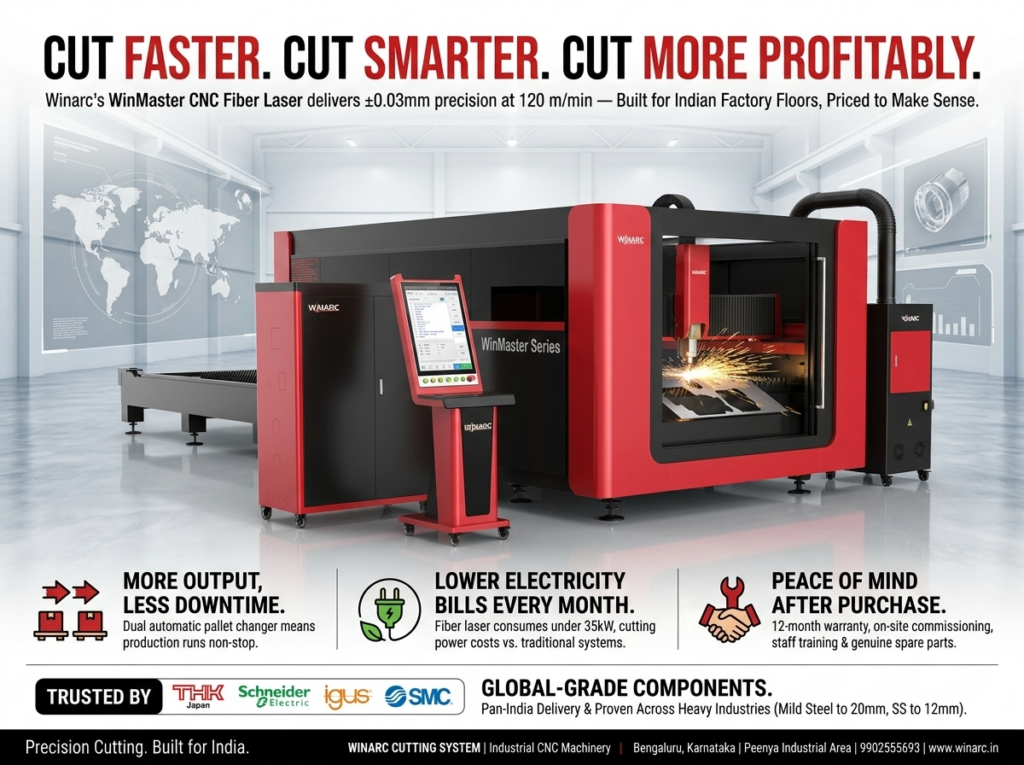
The machine frame is the foundation of long-term accuracy. A frame properly stress-relieved before machining holds its dimensional accuracy for years. A frame that skips stress relief will show progressive warping within 18 months of heavy production use. Winarc builds all machine beds from MS structural tubes and plate fabrication, stress-relieved before machining, which is the foundation of the ±0.03 mm positioning accuracy the WinMaster delivers across its operational life.
### Automatic pallet changer
An automatic dual pallet changer allows one sheet to be unloaded and a new sheet loaded while the machine continues cutting the previous sheet. Without a pallet changer, cutting stops during every sheet change. For high-production environments, this single feature can increase effective machine utilisation from 60% to 85% or more, a significant productivity difference that compounds across every shift.
### Cutting head specification
The cutting head is the component closest to the material. A quality cutting head maintains precise focus height automatically as material surface variation occurs, delivers consistent beam quality, and retracts before damage on collision. A cheap cutting head does none of these reliably and costs more in downtime and lens replacements than the saving on the purchase price.
What to do instead: When evaluating any quotation for buying a fiber laser cutting machine, request a full component specification list covering the laser source brand and model, servo motor brand and specification for each axis, linear guide brand, cutting head brand and model, CNC controller brand and software version, and pallet system specification. Compare these component by component across quotations, not just the laser power and the total price.
Mistake 5: Buying a Machine That Does Not Match Your Material Mix
The final major mistake when buying a fiber laser cutting machine is purchasing a machine optimised for a material or thickness range that does not match your actual production.
This happens because buyers describe their requirements in general terms, such as “we cut steel and aluminium”, without specifying the exact thickness range, the proportion of each material, and the required edge quality. The supplier then quotes the machine that fits the general description, which may not be the right machine for the specific production reality.
Here is a common example. A fabrication shop cuts mostly mild steel plates from 10 mm to 25 mm, with occasional stainless steel sheets at 2 to 3 mm. They describe this as “mixed metal cutting” and the supplier recommends a 6 kW fiber laser cutting machine. The machine handles the stainless steel well but struggles on the thicker mild steel, as operating cost rises sharply above 20 mm, cutting speed drops, and edge quality degrades on the heaviest plates.
The right machine for this production mix may actually be a [CNC plasma cutting machine](/products/cnc-plasma-cutting-machine) for the thick mild steel work and a fiber laser machine for the thin stainless steel, or a combination machine that switches between processes. Buying a fiber laser cutting machine for an application that primarily involves thick mild steel above 25 mm is a common mismatch that results in permanently high operating costs.
Similarly, a buyer who cuts copper and brass alongside mild steel must specify this when buying a fiber laser cutting machine. Fiber laser handles copper and brass reliably, but only if the laser source is properly specified for high-reflectivity material cutting. An underpowered or incorrectly configured laser source will deliver poor results on these materials regardless of the power rating on the brochure.
The [Indian Machine Tool Manufacturers’ Association (IMTMA) advises manufacturers evaluating CNC cutting equipment to define their complete material matrix before engaging suppliers, including all materials cut, their full thickness range, and the required edge quality standard.
Before buying a fiber laser cutting machine, prepare a production specification document. List every material you cut, the thickness range for each, the required dimensional tolerance, the required edge finish, and the approximate volume in metres per month. Share this document with every supplier and ask them to justify their machine recommendation against each line. If a supplier recommends the same machine regardless of what you tell them about your production, that is a red flag worth taking seriously.
Quick Reference: Checklist for Buying a Fiber Laser Cutting Machine
Before signing any purchase order, confirm you have answers to all of these:
**Machine specification checklist:**
– Laser source brand, model, and power rating confirmed
– Servo motors on all axes confirmed in writing
– Frame stress-relieved before machining confirmed
– Cutting head brand and collision protection confirmed
– Pallet system: manual or automatic dual pallet changer confirmed
– CNC controller brand and nesting software included confirmed
– Warranty document read in full before signing
**Supplier verification checklist:**
– Manufacturer location and service engineer location confirmed
– Factory visit arranged and demonstration cut completed on your material
– Domestic spare parts availability confirmed with lead times in writing
– Customer references (12 months+) contacted directly
– Total cost of ownership calculated, not just purchase price compared
**Production match checklist:**
– Laser power confirmed against your cutting speed requirement
– Full material matrix documented and machine specification confirmed against it
– Application confirmed as suitable for fiber laser (not plasma or oxyfuel)
The Best Fiber Laser Cutting Machine In India
India’s fiber laser cutting machine market is growing rapidly as manufacturers demand faster cutting speeds, precision, and lower operating costs. Among the leading solutions,
Winarc offers the WinMaster dual-pallet fiber laser cutting machine, known for high productivity, energy efficiency, and accurate sheet-metal fabrication. Other notable players include the ByStar Fiber by Bystronic, TruLaser series by TRUMPF, P Series by Bodor Laser, and iNspire by Eagle Laser. These advanced machines are widely used across automotive, aerospace, HVAC, and heavy engineering industries for reliable, high-speed metal cutting.
Top 10 Fiber Laser Cutting Machine Manufacturers In India
India’s metal fabrication sector is rapidly adopting advanced fiber laser cutting technology for faster production, precision, and automation. Here are some of the leading manufacturers and brands shaping the Indian market:
- Winarc – Known for the WINMASTER dual-pallet fiber laser cutting machine designed for high-speed industrial cutting.
- TRUMPF India – Global leader offering TruLaser series for automotive and aerospace industries.
- Bystronic India – Popular for smart factory integration and automation-ready laser systems.
- Bodor Laser India – Fast-growing brand with ultra-high-power fiber laser solutions.
- Prima Power India – Offers advanced sheet metal processing and laser cutting systems.
- Amada India – Well-known for reliable high-performance laser cutting machines.
- Mazak Optonics – Provides premium fiber laser systems with automation capabilities.
- Messer Cutting Systems India – Specializes in industrial laser and plasma cutting technologies.
- ProArc India – Indian manufacturer delivering CNC fiber laser cutting solutions for heavy industries.
- Coherent India – Global laser technology company serving precision manufacturing applications.