Choosing a laser cutting machine for thick metal plate processing is one of the most consequential decisions a metal fabricator or steel processing company makes. Get it right and you gain a machine that delivers consistent, clean cuts on heavy plate for a decade. Get it wrong and you end up with an expensive bottleneck, high operating costs, and edges that require time-consuming secondary grinding.
Thick metal plate processing is technically demanding. As plate thickness increases above 12 mm, the physics of laser cutting changes significantly. Power requirements increase sharply. Assist gas dynamics become critical. Kerf quality degrades if the machine is not correctly specified for the thickness range. And the economic calculation shifts: at a certain thickness, fiber laser gives way to plasma or oxyfuel as the more cost-effective process.
This guide covers everything a fabricator needs to know when selecting a laser cutting machine for thick metal plate processing. Whether you are evaluating your first laser cutting machine for thick metal plate processing or upgrading existing capacity: how thickness affects machine selection, which technology is right for each thickness range, what specifications actually matter, and how Indian manufacturers like Winarc approach thick plate cutting with the WinPro and WinMaster.
Peer-reviewed research published in IOP Engineering Research Express highlights the growing importance of optimised laser cutting processes for industrial metal plate applications, confirming that process parameter selection is as critical as machine specification for achieving consistent quality on thick plate.
What Counts as Thick Metal Plate for Laser Cutting Purposes?
In the context of a laser cutting machine for thick metal plate processing, “thick” is a relative term that depends on the technology being used.
For a fiber laser cutting machine, the standard industry benchmark is:
- Thin sheet: 0.5 mm to 6 mm
- Medium plate: 6 mm to 12 mm
- Thick plate: 12 mm to 25 mm
- Ultra-thick plate: above 25 mm
For plasma cutting, the threshold shifts: heavy plate is typically considered 25 mm to 50 mm, with ultra-heavy above 50 mm.
For oxyfuel cutting, thick plate begins at approximately 25 mm and extends to 350 mm.
Understanding where your primary production falls within these ranges is the essential first step before selecting any laser cutting machine for thick metal plate processing.
How Plate Thickness Affects Laser Cutting Physics
The challenges of any laser cutting machine for thick metal plate processing are rooted in physics, not machine quality.
Power density requirements increase with depth. A laser cutting machine cuts by focusing energy onto a small spot, melting the metal, and ejecting the molten material with assist gas. As thickness increases, the laser must maintain enough energy density across the full depth of the cut. At 3 mm, a 3 kW fiber laser achieves this easily. At 20 mm, the same machine struggles. At 30 mm, it is operating beyond its effective range.
Assist gas dynamics become critical. The assist gas (oxygen for mild steel, nitrogen for stainless steel) serves two functions: it drives the chemical cutting reaction (oxygen) or blows molten metal from the kerf (nitrogen). In thick plate, the gas must penetrate the full depth of the cut at sufficient pressure to eject molten material from the bottom of the kerf. If gas pressure, nozzle design, or standoff distance is incorrect, dross accumulates on the lower edge and edge quality degrades.
Heat-affected zone (HAZ) grows with thickness. The thicker the plate, the longer the laser dwells at any point to complete the cut, and this extended dwell time increases the HAZ, which is the zone of material alongside the cut edge that is thermally altered. A wide HAZ can affect dimensional accuracy and weld preparation quality on the cut edge.
Cutting speed slows significantly. A 6 kW fiber laser cuts 3 mm mild steel at approximately 13 to 15 metres per minute. The same machine cuts 20 mm mild steel at approximately 0.8 to 1.5 metres per minute. The inverse relationship between thickness and cutting speed is fundamental to the economics of thick plate laser processing.
Fiber Laser Cutting Machine for Thick Metal Plate Processing: What Is Achievable?
A high-power fiber laser cutting machine for thick metal plate processing delivers excellent results on plates up to 25 mm, with specific conditions.
Mild steel up to 25 mm. With oxygen assist gas and correct process parameters, a 6 kW to 12 kW fiber laser cutting machine produces clean cuts on mild steel up to 25 mm with acceptable edge quality for most structural and fabrication applications. Above 25 mm, operating cost rises sharply and edge quality becomes harder to maintain consistently.
Stainless steel up to 15 mm. Stainless steel is less thermally conductive than mild steel, which actually helps thick plate cutting, as heat stays in the cutting zone longer. High-pressure nitrogen assist gas is essential for stainless steel to prevent oxidation of the cut edge. At 10 kW and above, fiber laser produces clean cuts on stainless steel up to 15 mm.
Aluminium up to 10 mm. Aluminium’s high thermal conductivity makes thick plate cutting challenging even for fiber laser. Above 10 mm, cut quality degrades unless laser power is sufficient to overcome rapid heat dissipation.
The right laser power for thick metal plate laser cutting depends on your primary material and thickness:
| Material | 6 mm to 12 mm | 12 mm to 20 mm | 20 mm to 25 mm |
|---|---|---|---|
| Mild steel | 3 kW to 6 kW | 6 kW to 10 kW | 10 kW to 15 kW |
| Stainless steel | 6 kW | 8 kW to 12 kW | 12 kW to 20 kW |
| Aluminium | 6 kW | 10 kW to 12 kW | 12 kW+ |
For Indian fabricators looking at pricing at each power level, our complete Steel Laser Cutting Machine Price in India 2026 guide breaks down costs by laser power from 2 kW to 20 kW.
Key Specifications for a Laser Cutting Machine for Thick Metal Plate Processing
When evaluating a laser cutting machine for thick metal plate processing, matching specifications to your actual production requirements is essential.
Laser power rating
This is the primary specification. Higher power delivers faster cutting speed and cleaner edges on thick plate. For serious thick plate processing above 15 mm, a minimum of 6 kW is the production standard. For plates above 20 mm at high volume, 10 kW to 20 kW is the correct specification range.
Laser source beam quality (BPP)
Beam Parameter Product (BPP) measures the focusability of the laser beam. A lower BPP means a tighter focus, higher energy density at the focal point, and better performance on thick plate. High-quality fiber laser sources maintain low BPP values even at high power levels, which directly enables better thick plate cutting performance.
Cutting head and focus control
For thick plate laser cutting, the cutting head must maintain precise focus depth and standoff distance as the nozzle traverses the plate. An automatic cutting head with real-time focus control, capacitive height sensing, and collision protection is essential. On thick plate, any deviation in standoff distance immediately affects edge quality.
Assist gas system specification
For thick mild steel, oxygen assist gas at 0.5 to 2 bar drives the exothermic cutting reaction that enables efficient thick plate cutting. For stainless steel and aluminium, high-pressure nitrogen at 8 to 20 bar blows the melt from the kerf. The gas system must supply sufficient pressure and flow rate for the plate thickness range. This is a specification many buyers overlook until they experience dross problems in production.
Machine frame rigidity
Thick plate imposes greater forces on the machine frame during cutting due to higher gas pressures and longer cut durations. A stress-relieved, precision-machined gantry frame maintains positional accuracy under these sustained loads. Winarc’s WinPro is specifically designed as a gantry-type machine mounted on precision-machined railway rails for exactly this reason: it delivers vibration-free, stable motion at high cutting pressures on large-format thick plate.
Drive system under load
Dual synchronised servo motors on the longitudinal axis maintain positioning accuracy even during the slower, higher-force motion of thick plate cutting. Stepper motor drives lose positional accuracy under sustained production loads, which is why servo drives are the non-negotiable specification for any serious laser cutting machine for thick metal plate processing.
Fiber Laser vs High-Power Plasma: The Thick Plate Decision
For metal plates above 25 mm, the economic equation for laser versus plasma shifts decisively.
A fiber laser cutting machine for thick metal plate above 25 mm requires very high laser power (12 kW to 20 kW), high assist gas consumption, and significantly reduced cutting speed. The operating cost per metre of cut on 30 mm mild steel using a 15 kW fiber laser is substantially higher than on the same material using a high-amperage plasma cutting system.
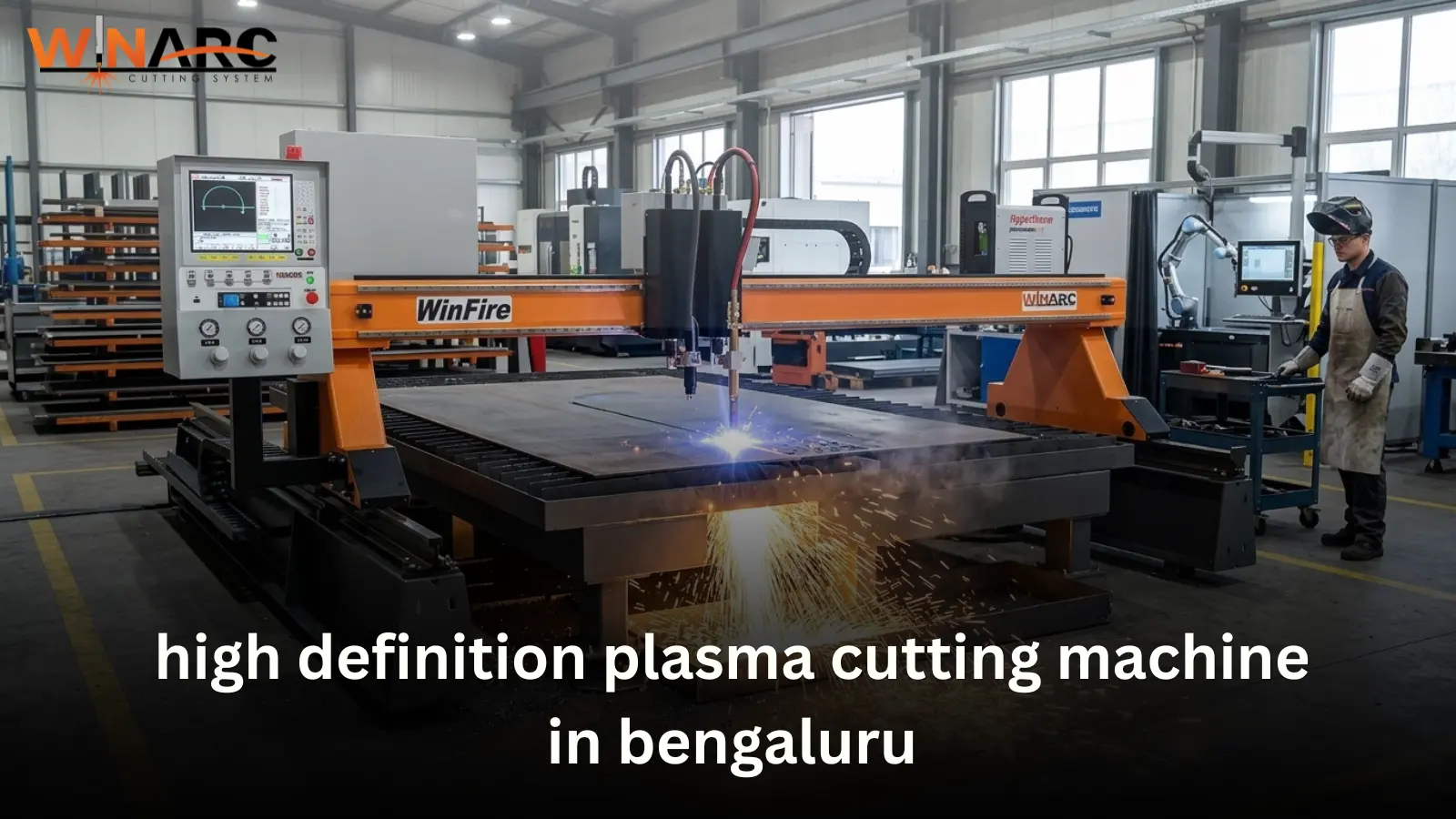
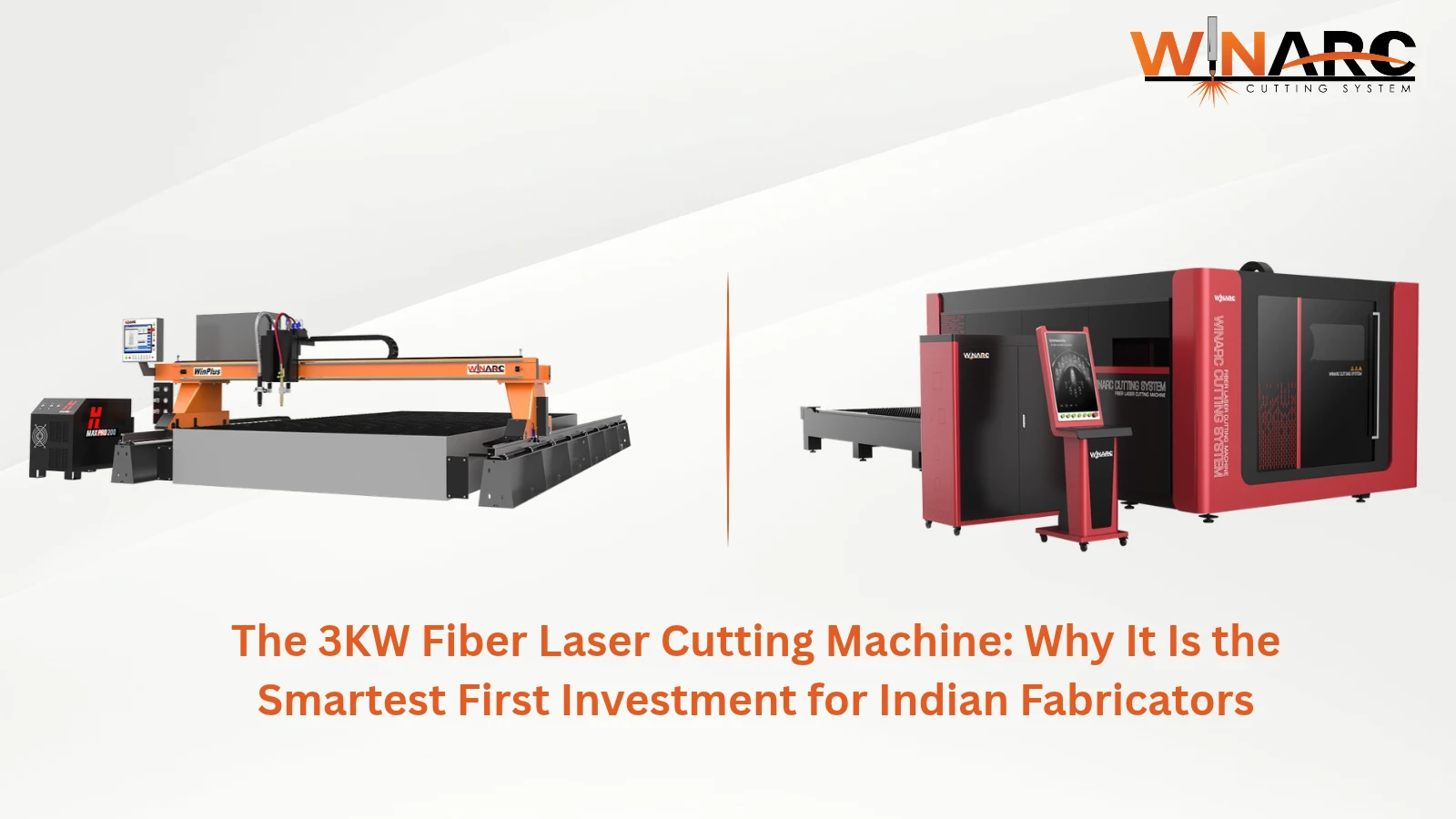
This is why many Indian fabricators processing thick structural plate use a combination approach: a fiber laser cutting machine for plates up to 20 mm to 25 mm where edge quality justifies the investment, and a CNC plasma cutting machine for plates above this threshold where speed and operating economy matter more than absolute edge precision.
| Thickness | Recommended process | Reason |
|---|---|---|
| Up to 6 mm | Fiber laser | Fastest, best edge quality |
| 6 mm to 12 mm | Fiber laser | Excellent quality, economical |
| 12 mm to 20 mm | Fiber laser (6 kW to 10 kW) | Best quality option, manageable cost |
| 20 mm to 25 mm | Fiber laser (10 kW+) or HD plasma | Economic decision based on volume |
| 25 mm to 50 mm | CNC plasma cutting | Better economy, adequate quality |
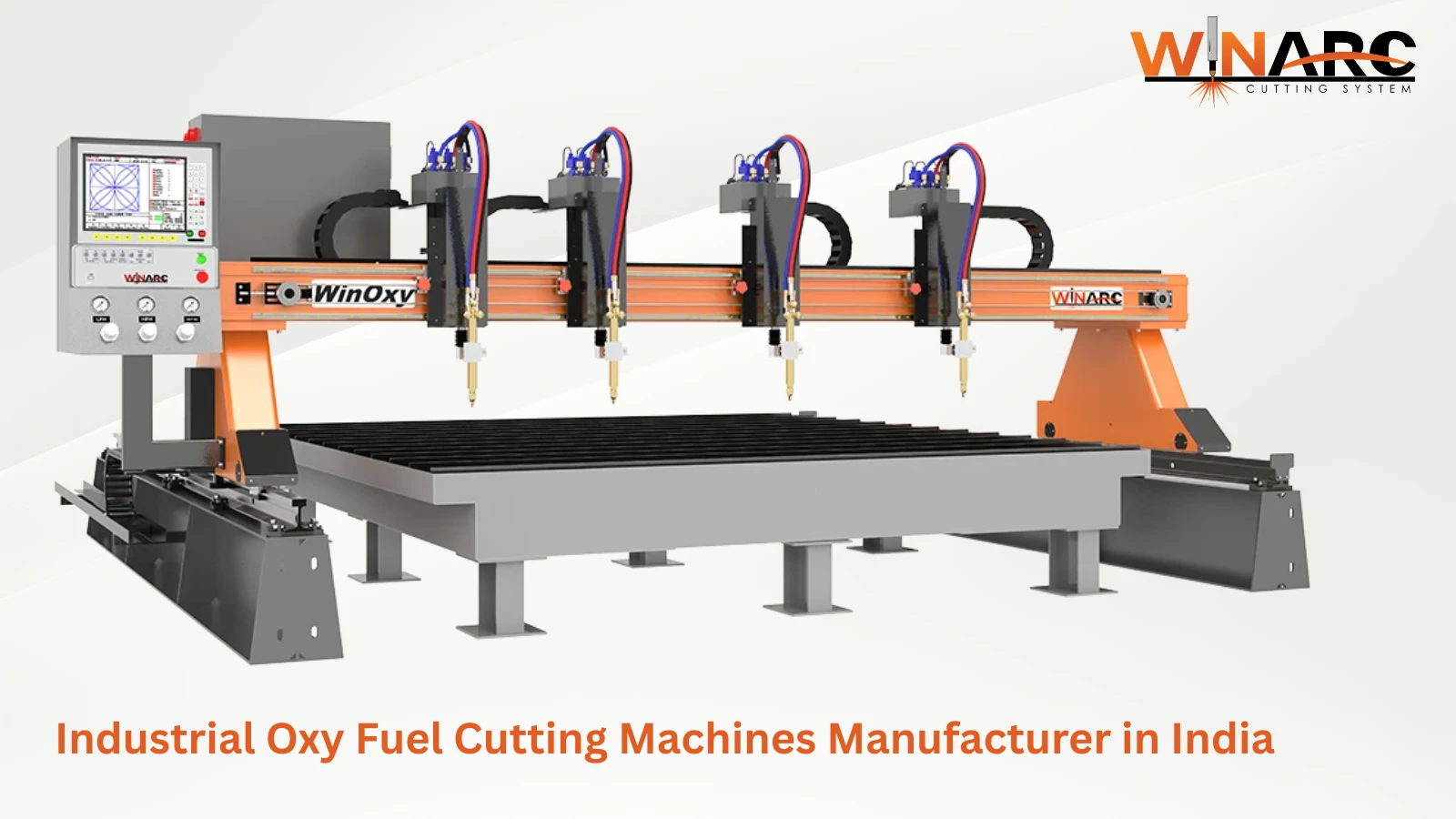
| 50 mm to 350 mm | CNC oxyfuel cutting | Only cost-effective option |
Winarc Machines for Thick Metal Plate Laser Cutting
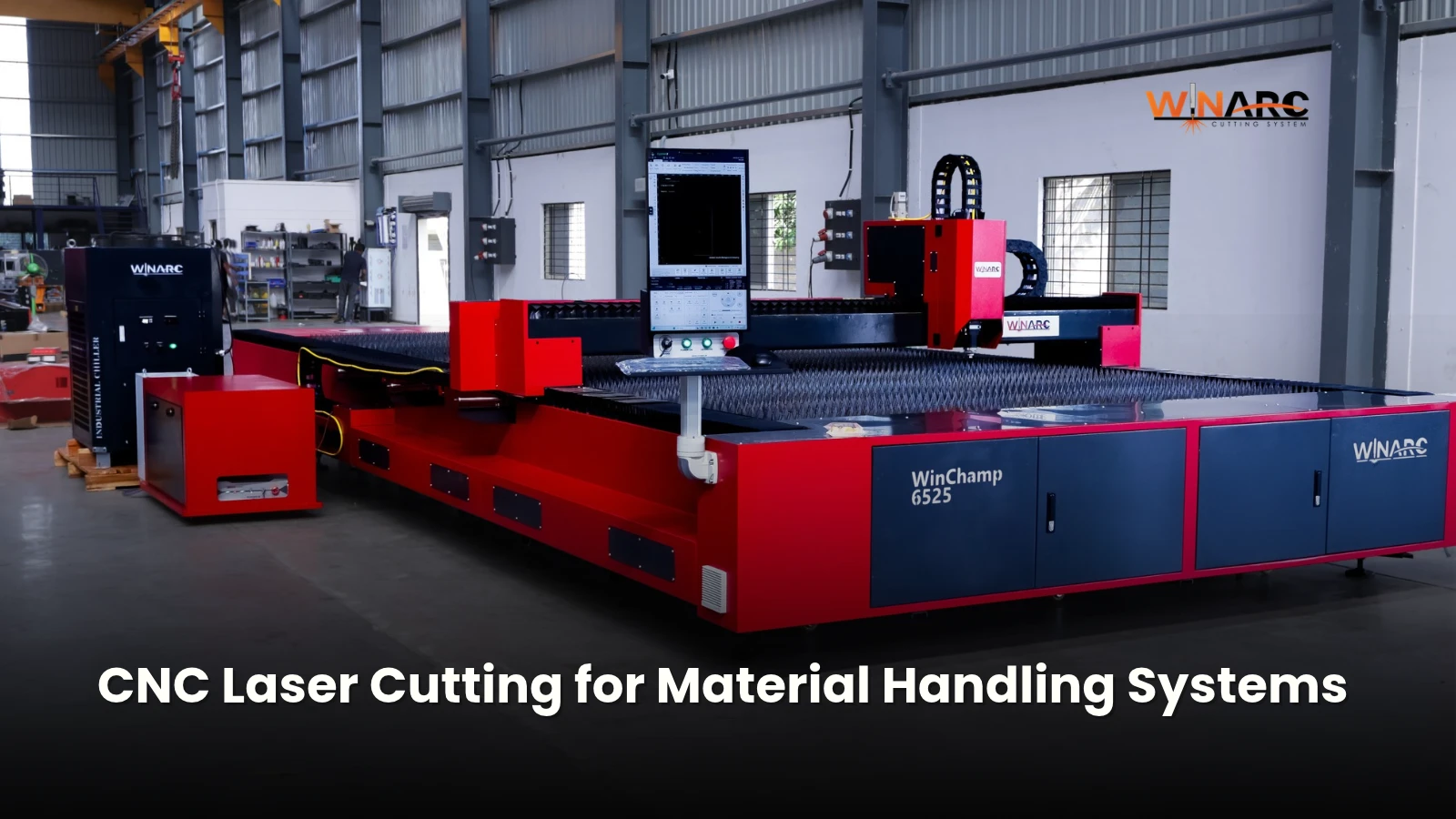
As CNC laser cutting machine manufacturers based in Peenya, Bangalore, Winarc builds machines specifically suited to Indian heavy plate fabrication environments.
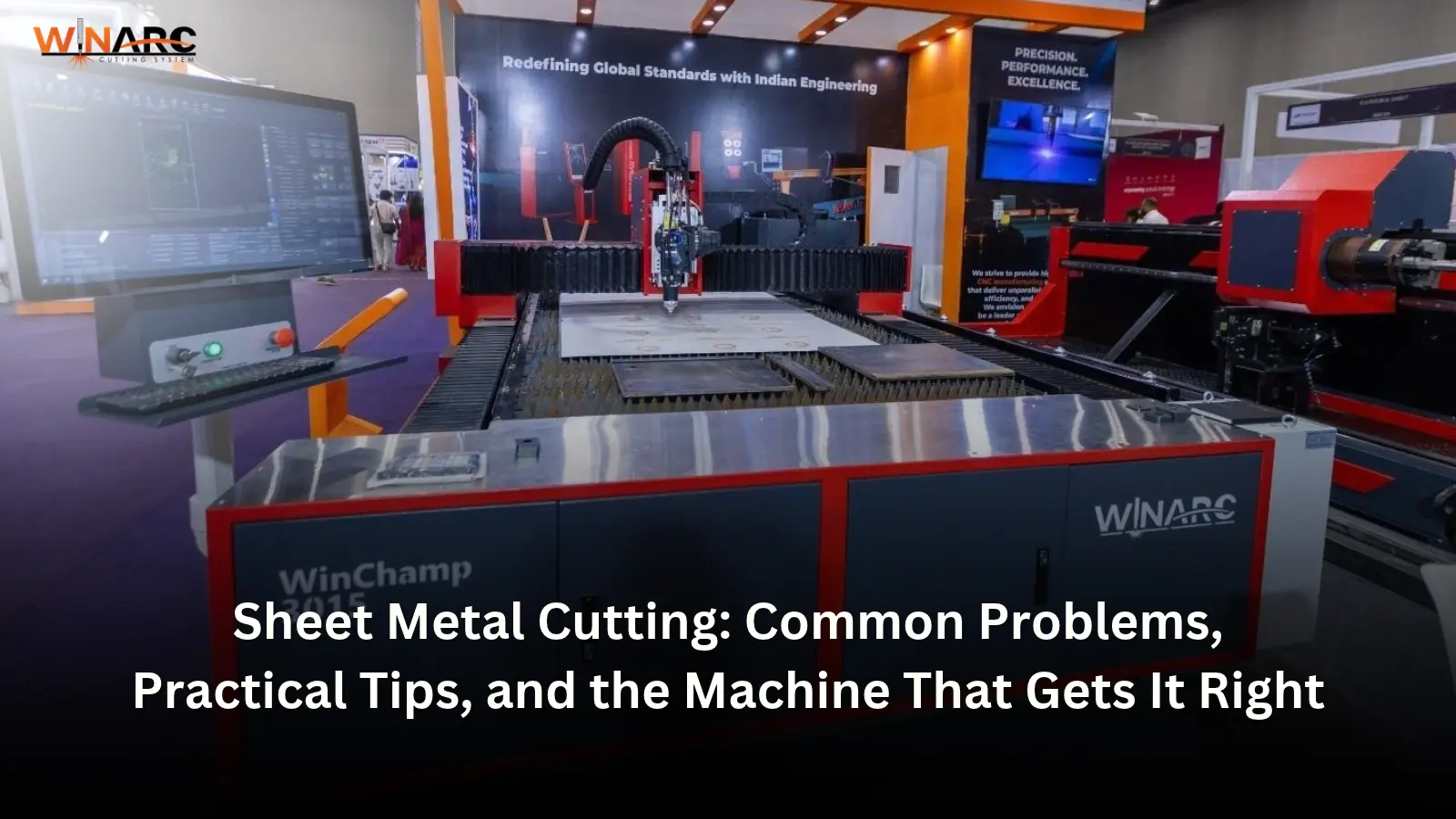
WinPro: Gantry Fiber Laser Cutting Machine for Thick Plate
The WinPro is Winarc’s dedicated thick plate fiber laser cutting machine. Its gantry design mounted on precision-machined railway rails delivers the structural rigidity and vibration-free motion that thick plate processing demands.
WinPro thick plate specifications:
| Specification | WinPro |
|---|---|
| Working area | Up to 8000 mm x 3000 mm |
| Laser power | 2 kW to 20 kW |
| Max axis speed | 120 m/min |
| Positioning accuracy | ±0.03 mm |
| Frame | Precision-machined gantry on railway rails |
| Drive system | Dual synchronised servo motors |
| Cutting capacity (6 kW) | MS 25 mm, SS 12 mm, Al 6 mm |
| Cutting capacity (12 kW) | MS 40 mm, SS 20 mm, Al 12 mm |
| Assist gas | Oxygen and high-pressure nitrogen |
The WinPro’s large working area accommodates full-size structural steel plates without repositioning, which is critical for thick plate fabrication where repositioning mid-cut introduces dimensional errors.
WinMaster: High-Power Dual Pallet Fiber Laser for Thick Sheet Production
For fabricators cutting thick sheet at high production volumes, the WinMaster offers 2 kW to 20 kW laser power with an automatic dual pallet changer that maintains continuous production. While one sheet is being cut, the next is loaded, eliminating idle time between sheets.
At 10 kW to 20 kW, the WinMaster handles mild steel up to 30 mm+ at production speeds that make high-volume thick plate fabrication economically viable.
Explore how Winarc powers industries with CNC precision across a range of thick plate and sheet metal applications.
Industries That Use Laser Cutting Machines for Thick Metal Plate Processing in India
Shipbuilding and ship repair. Hull plates, structural frames, and deck sections are cut from mild steel from 15 mm to 50 mm. A laser cutting machine for thick metal plate processing handles the 15 mm to 25 mm range at the quality levels shipbuilding specifications require.
Bridge and infrastructure fabrication. Structural steel for road and rail bridges uses heavy plate sections for web plates, flange plates, and gussets. Precision cuts from a thick plate laser machine reduce fitting time at the fabrication yard.
Heavy engineering and construction equipment. Excavator arms, bulldozer buckets, crane booms, and loader frames are fabricated from 20 mm to 50 mm mild steel. A laser cutting machine for thick metal plate at the appropriate power level delivers cleaner edges and tighter tolerances than plasma on this thickness range.
Pressure vessel and boiler fabrication. Thick mild steel shells, heads, and nozzle pads require precise, clean cuts with minimal heat-affected zone for quality weld preparation. Fiber laser achieves this on thicknesses up to 25 mm.
Defence and armour fabrication. Armoured vehicle components and defence structure plates use high-strength steel in thicknesses from 10 mm to 40 mm. Laser cutting delivers the dimensional precision that defence specifications demand.
Power plant and energy sector fabrication. Transformer housings, generator frames, and turbine base structures use thick mild steel plate cut to close dimensional tolerances. A laser cutting machine for thick metal plate at 10 kW to 12 kW handles this effectively.
Assist Gas Selection for Thick Plate Laser Cutting
The assist gas is the most underspecified parameter when buying a laser cutting machine for thick metal plate processing. Getting it wrong results in dross, rough edges, and discolouration regardless of machine quality.
Oxygen for mild steel thick plate. Oxygen drives an exothermic chemical reaction that supplements the laser energy, enabling faster cutting speeds on thick mild steel at lower laser power than would otherwise be required. For mild steel above 10 mm, oxygen assist is the standard process. The cut edge has a characteristic dark oxide layer which is acceptable for welding applications.
High-pressure nitrogen for stainless steel thick plate. Nitrogen prevents oxidation of the cut edge, producing a bright, clean surface on stainless steel. Nitrogen pressure requirements increase with thickness: at 15 mm stainless, pressures of 15 to 20 bar are standard. The gas system must be rated for this pressure range.
Nitrogen for aluminium thick plate. Nitrogen assist prevents aluminium oxidation during cutting, producing clean edges. High flow rates are required to overcome aluminium’s tendency to form dross on the lower edge of thick sections.
Common Challenges in Thick Plate Laser Cutting and Their Solutions
Dross on the lower edge. This is the most common problem in thick metal plate laser cutting and indicates incorrect process parameters, typically insufficient assist gas pressure, incorrect focal position, or laser power too low for the thickness. Solution: verify focal point position is at the correct depth within the plate (not at the top surface), increase assist gas pressure, and confirm laser power is adequate for the material and thickness.
Top-edge rounding. This occurs when laser power or cutting speed causes excessive heat at the top surface. Solution: increase cutting speed slightly or reduce laser power. In thick plate, the balance between power and speed is narrower than on thin sheet.
Striations on the cut face. Striations (parallel lines on the cut face) indicate unstable melt ejection. In thick plate, this often results from insufficient gas pressure at depth. Solution: increase gas pressure, optimise nozzle standoff, and verify that the gas system flow rate is adequate for the plate thickness.
Dimensional inaccuracy on large plates. Large thick plates have more thermal expansion during cutting than small plates. The machine must compensate for this through correct cutting sequence programming, typically cutting from the centre of the plate outward to manage thermal distortion.
For mild steel thick plate from 12 mm to 20 mm, a 6 kW to 10 kW fiber laser cutting machine is the standard specification. For 20 mm to 25 mm mild steel, 10 kW to 15 kW is recommended for production-speed cutting. Above 25 mm thick mild steel, CNC plasma cutting is typically more economical than high-power fiber laser. For stainless steel thick plate, laser power requirements are approximately 30 to 40% higher than for mild steel at equivalent thicknesses.
For mild steel up to 25 mm, a high-power fiber laser cutting machine for thick metal plate processing delivers better edge quality, tighter tolerances, and lower kerf width than plasma. Above 25 mm, plasma cutting becomes more economical in operating cost with adequate edge quality for structural applications. The right choice depends on your primary thickness range, required edge quality, and production volume. Many Indian fabricators use fiber laser for plates up to 20 mm to 25 mm and plasma for heavier sections.
A fiber laser cutting machine suitable for thick metal plate processing in India starts from approximately Rs 22 lakh for a 6 kW configuration at standard bed size. High-power 10 kW to 20 kW configurations suitable for plates above 20 mm range from Rs 45 lakh to Rs 1 crore and above. For a detailed breakdown by laser power and bed size, read our Steel Laser Cutting Machine Price in India 2026 guide.
A high-power fiber laser cutting machine (15 kW to 20 kW) can technically cut mild steel up to 40 mm. However, the practical production limit where edge quality and operating economy are both acceptable is typically 25 mm to 30 mm. Above 30 mm mild steel, plasma cutting and oxyfuel cutting become significantly more cost-effective. For stainless steel, the practical limit for fiber laser is approximately 20 mm. For aluminium, approximately 12 mm to 15 mm with high-power laser.